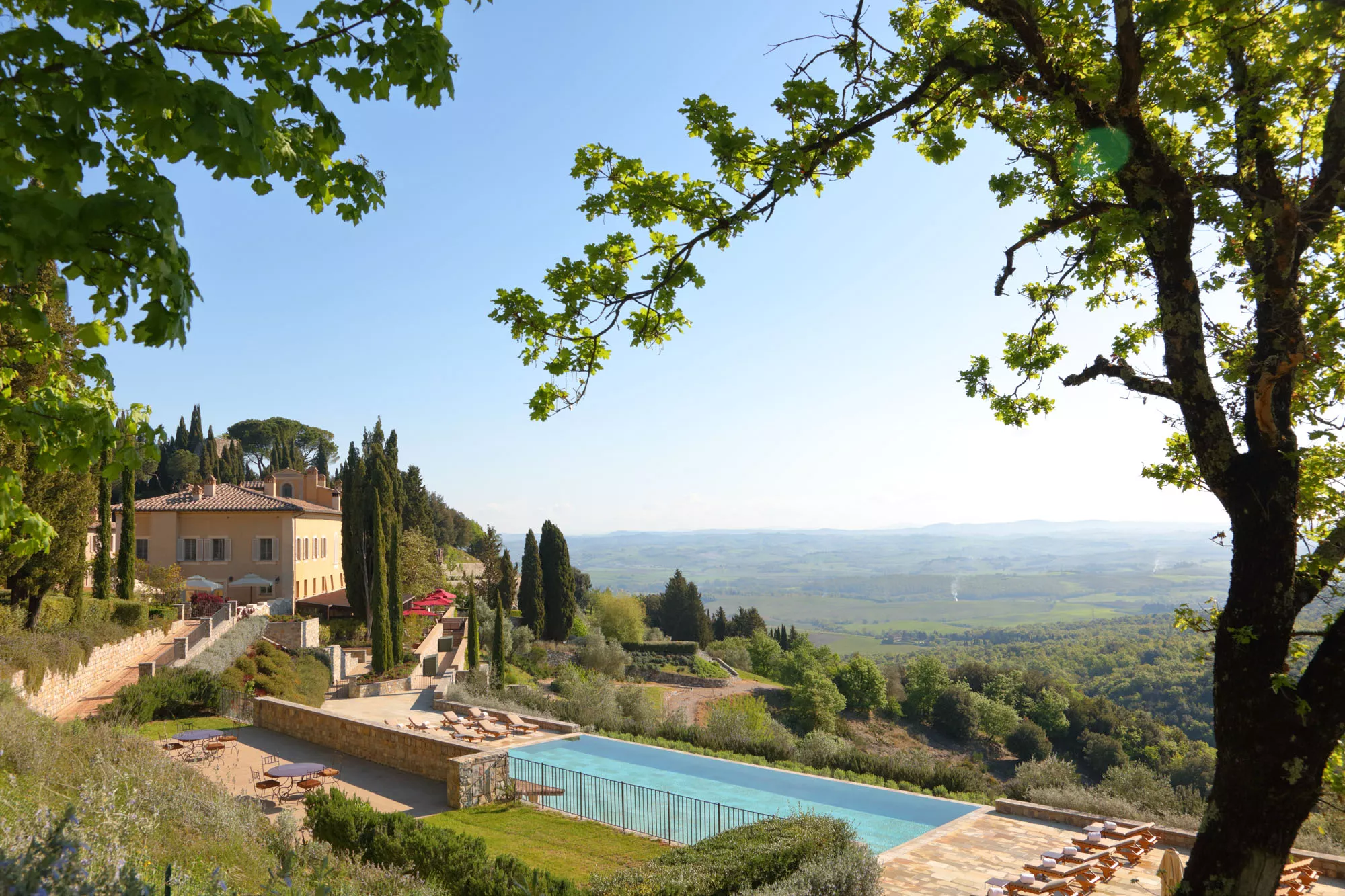
I have a theory about truly exceptional hotels: you know you’re in one the moment you stop thinking about where you are and simply start being there. That shift happened for me at Castiglion del Bosco somewhere between the second glass of Brunello and the moment I looked up from the terrace to find a hawk circling lazily above the Val d’Orcia and thought, with absolute sincerity, that I had never been anywhere more beautiful in my life.
The drive up to the estate alone was a kind of slow theatre. The road winds up through forested slopes, past vineyards threaded between ancient stone walls, before the 12th-century castle materialises on the hilltop like something you’ve invented in a daydream. It rises from the landscape with the serene self-assurance of a place that has absolutely nothing to prove. No grand gates, no elaborate reception ceremony, just an unhurried arrival into what feels, immediately, like somewhere deeply, quietly right.
Setting the Scene
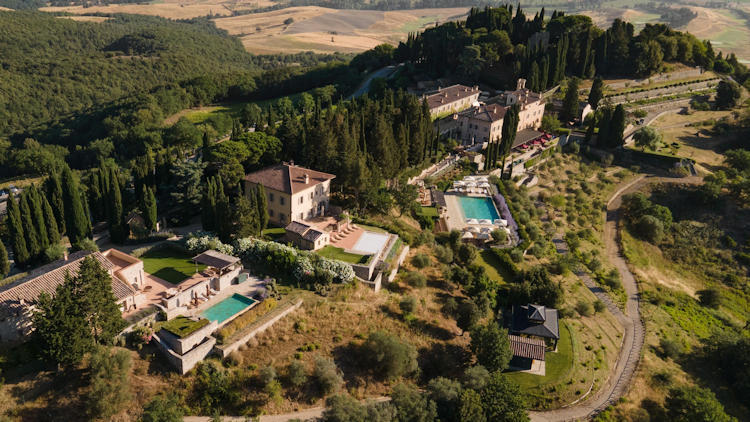
The estate covers 5,000 hectares and sits just south of Siena in the UNESCO-protected Val d’Orcia valley, and while those statistics are impressive on paper, they mean little until you’re standing on the hill watching the light move across the landscape in long golden sheets. The vineyards roll away in every direction. Stone farmhouses draped in creeping vines dot the slopes. It reminded me of a Corot painting; the kind of landscape that looks idealised but is, in fact, simply real, and all the more astonishing for it.
The estate was founded in the 1100s as a borgo, a self-contained hilltop village, and it has held onto that essential identity through every subsequent century. In 2003, Massimo Ferragamo: yes, of those Ferragamos ; and his wife Chiara bought the property and undertook a meticulous restoration of the 17th- and 18th-century farmhouses and agricultural outbuildings. When Rosewood Hotels & Resorts took over in 2015, they were wise enough to leave Chiara’s interiors entirely alone. She still oversees that side of operations, and it shows.
The Villa
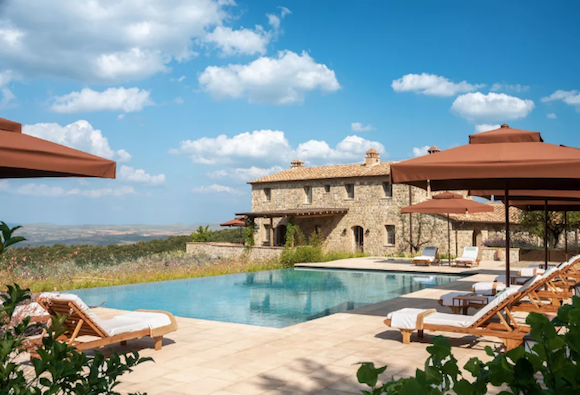
I stayed in Sant’Anna, a five-bedroom villa that had once, in its past life, stored grain. That might sound like an odd selling point, but the former granary’s proportions: generous ceiling heights, thick stone walls, windows that frame the hills like paintings; made it one of the most quietly spectacular spaces I’ve slept in. The front door opens directly into a living room that manages to be both expansive and deeply cosy, an architectural trick that I’m convinced only the Italians fully understand.
Chiara Ferragamo’s interiors are a masterclass in restraint. The palette: browns, rose greys, muted creams, deep maroon, feels as though it was pulled directly from the landscape outside. The walls are hung with animal drawings and oil portraits of Tuscan nobility, their expressions ranging from amused to faintly imperious. Antiques sourced from across Italy sit alongside quietly contemporary pieces: tusk-shaped lamp bases, leather-encased bar cabinets, throws folded over the arms of sofas with the careless precision that only real stylists achieve. Nothing shouts. Everything resonates.
The mornings in that villa were, I think, among the happiest I’ve spent anywhere. I came downstairs each day in the maroon velvet slippers; provided, naturally, to find breakfast already spreading itself across the dining table courtesy of our mama en villa, the resident cook who managed the impressive feat of making you feel simultaneously mothered and indulged. Fresh pastries. Local cheeses. Eggs cooked however you wanted them, without being asked. Truffle on things you hadn’t expected. There were lunches too, and dinners built around Tuscan delicacies, served in what I can only describe as a festive, lovingly orchestrated clutter. Outside, the villa’s private garden: olive trees, a swimming pool, a tennis court; waited with the patient hospitality of somewhere that understood your time was entirely your own.
Food and Beverages
For evenings when the villa kitchen felt too contained, the estate’s two restaurants offered very different but equally excellent experiences. Osteria la Canonica operates on the logic of a good Tuscan trattoria: unfussy, anchored in regional classics, and deeply satisfying. I had pappardelle with wild boar ragù one evening that I thought about for the rest of the trip. The Fiorentina T-bone steak is enormous and unapologetic. Dessert, overseen by pastry chef Michael Bovin; who has won Italy’s top Gambero Rosso award, arrived in the form of affogato with profiteroles, which turned out to be one of those things you eat slowly, almost reluctantly, because you don’t want it to end.
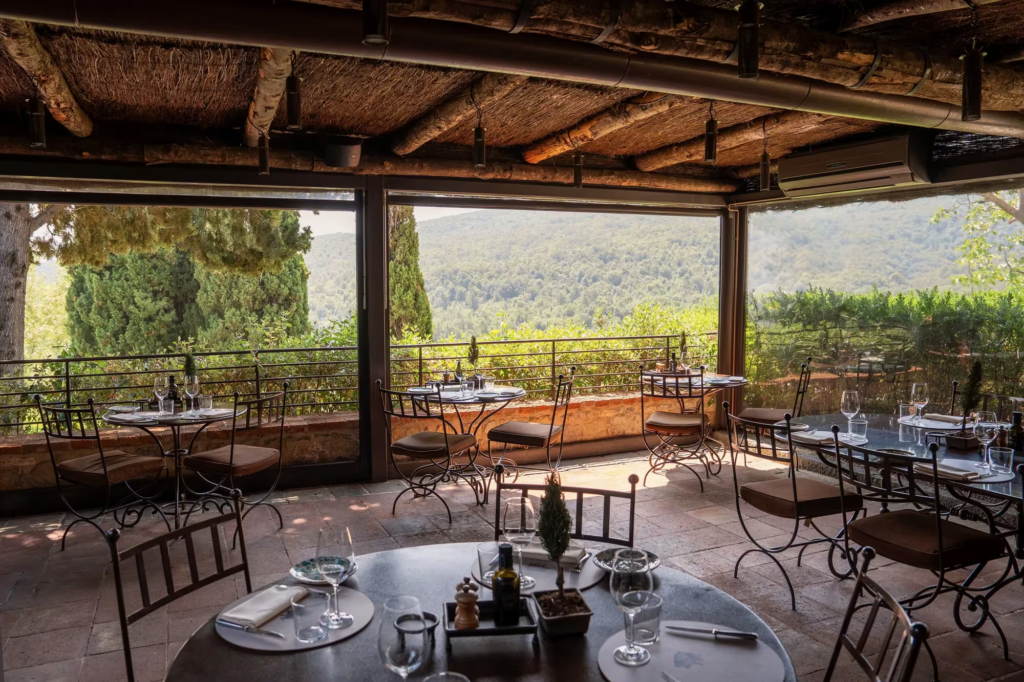
Ristorante Campo del Drago is a more considered affair, and rightly so; it holds two Michelin stars. Chef Matteo Temperini, a native Tuscan, pulls seasonal produce from the estate’s own organic kitchen garden and transforms it into dishes that manage to be technically rigorous without feeling cold or performative. I ate there once and took a table by the terrace windows, where Montalcino’s hills unfurled in the early evening light. The food felt like an extension of that view: local, honest, extraordinary.
But it is the wine that is Castiglion del Bosco’s most extraordinary offering. The estate produces nine varieties of Sangiovese, including Brunello di Montalcino, and it is the only winery in Tuscany that oversees every single stage of cultivation; from vine to bottle. I took the winery tour one afternoon, descending into subterranean fermentation tanks and moving through a 4,000-square-metre cellar that smelled of oak and patience.
The Ferragamos also founded a Winery Club, which holds gala dinners in the circular Members’ Cellar: a domed, atmospheric space lined with private lockers where members store their purchased vintages between visits. Names are displayed on the locker doors, and I spent rather too long trying to identify the American A-listers. I found two. I will say nothing more.
Wellness and the Spa
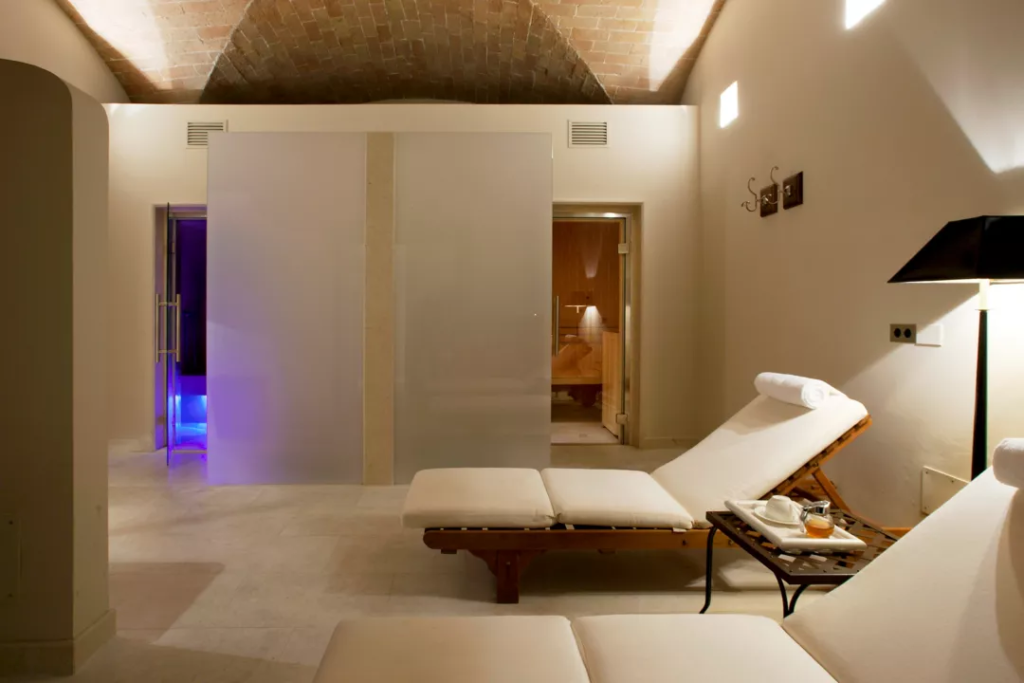
The spa complex offers the full repertoire: steam rooms, saunas, massages, clay detoxes, hydration facials, all using products by Farmaceutica Santa Maria Novella, the Florentine pharmacy and perfumery that has been operating since the 13th century. But it was the winter pool house that stayed with me longest. Approached from the higher elevations of the estate, it appears through the trees as a long glass pavilion, its floor-to-ceiling crittall windows filled entirely with the view of forested hills. I did a yoga class there one morning with instructor Shirley Shivhon, and spent most of it distracted by the landscape visible through every pane of glass. I regret nothing.
Exploring the Estate and Beyond
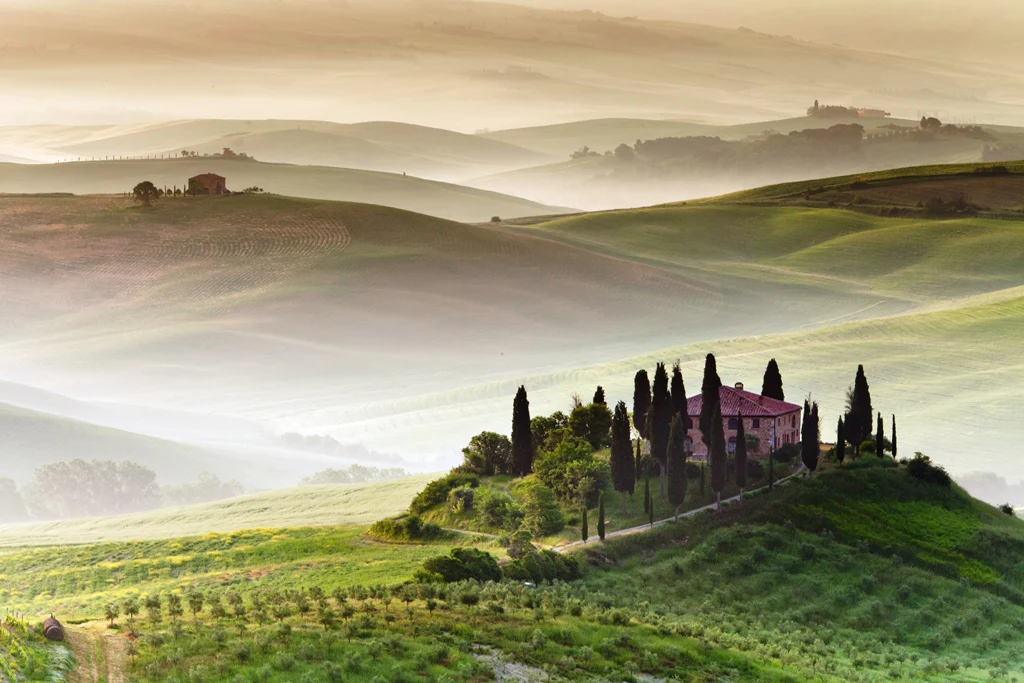
The surrounding hills offer bike rides through vine-striped countryside and painting classes set up in spots that make the task of landscape art feel almost dangerously easy. The golf course, Italy’s only private 19-hole course, is available to guests, its clubhouse a converted farmhouse with the easy comfort of somewhere designed for people who have already had a good day.
The truffle hunt was, unexpectedly, the experience I talked about most when I returned home. Led by Ernesto and Giovanni Giunta and their Lagotto Romagnolo; a breed expressly designed by centuries of Italian tradition for exactly this purpose; we moved through the woods on an autumn morning while the dog worked with an intensity and focus that made us all feel slightly underachieving. Finding a white truffle hidden beneath a root system, then eating it that same evening, felt like a small, complete narrative arc.
Further afield, Siena is accessible and worth an afternoon: particularly for the ceramicists, leather craftsmen and painters working in the old artisan workshops. The landscapes around Montalcino are also, as it turns out, cinematic in the literal sense: locations used for Gladiator and Zeffirelli’s Romeo and Juliet are both nearby, and visiting them you understand immediately why those directors chose them.
Final Thoughts
Castiglion del Bosco is not a hotel that tries to overwhelm you with amenities or impress you with grandeur. It offers something harder to manufacture: a sense of belonging to a place, briefly, in a way that feels genuine. The 900-year-old estate doesn’t strain to be relevant or luxurious. It simply is, in the most fundamental sense, exactly what it has always been; land, wine, stone, light; and invites you to slow down enough to understand why that is more than enough.
I left on a Tuesday morning, driving back down the hill through the vineyards while the valley was still in mist below. I thought about the Brunello. I thought about the truffle. I thought about the hawk.
I will go back.
Castiglion del Bosco, A Rosewood Hotel. Località Castiglion del Bosco, Montalcino, Siena. rosewoodhotels.com