An eel and aubergine tartare that upstages the menu around it, a lobster linguine two friends still contest, and a dessert built for lingering: Mykonos’s most famous beach club turns out to cook rather seriously, sea view or not.
There is a particular kind of relief that comes from walking into a room built for exactly the evening you are having. We arrived hungry, a little loud, ready to catch up on months of things left unsaid, and the room met us halfway before we had even sat down. The host greeted us as though we were expected rather than merely booked, which sounds like a small thing until one notices how rarely it happens. No sea view, no breeze off the water, nothing to recall that this was once a beach club’s idea of Mediterranean life. And somehow it did not matter. Nammos Mayfair does not try to convince you that you are somewhere else. It simply makes you forget, briefly, that you are in London at all, and by the time we were shown to our table I had already stopped checking my phone, which for me is close to the highest compliment a restaurant can earn before the food has even arrived.
Beige, Wood, Tile, and a Bar That Holds the Room
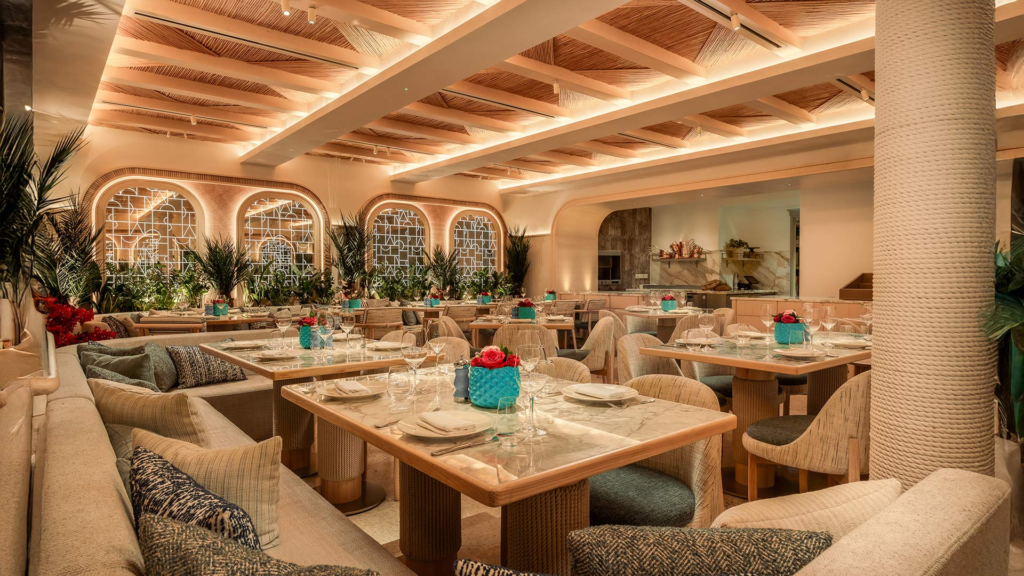
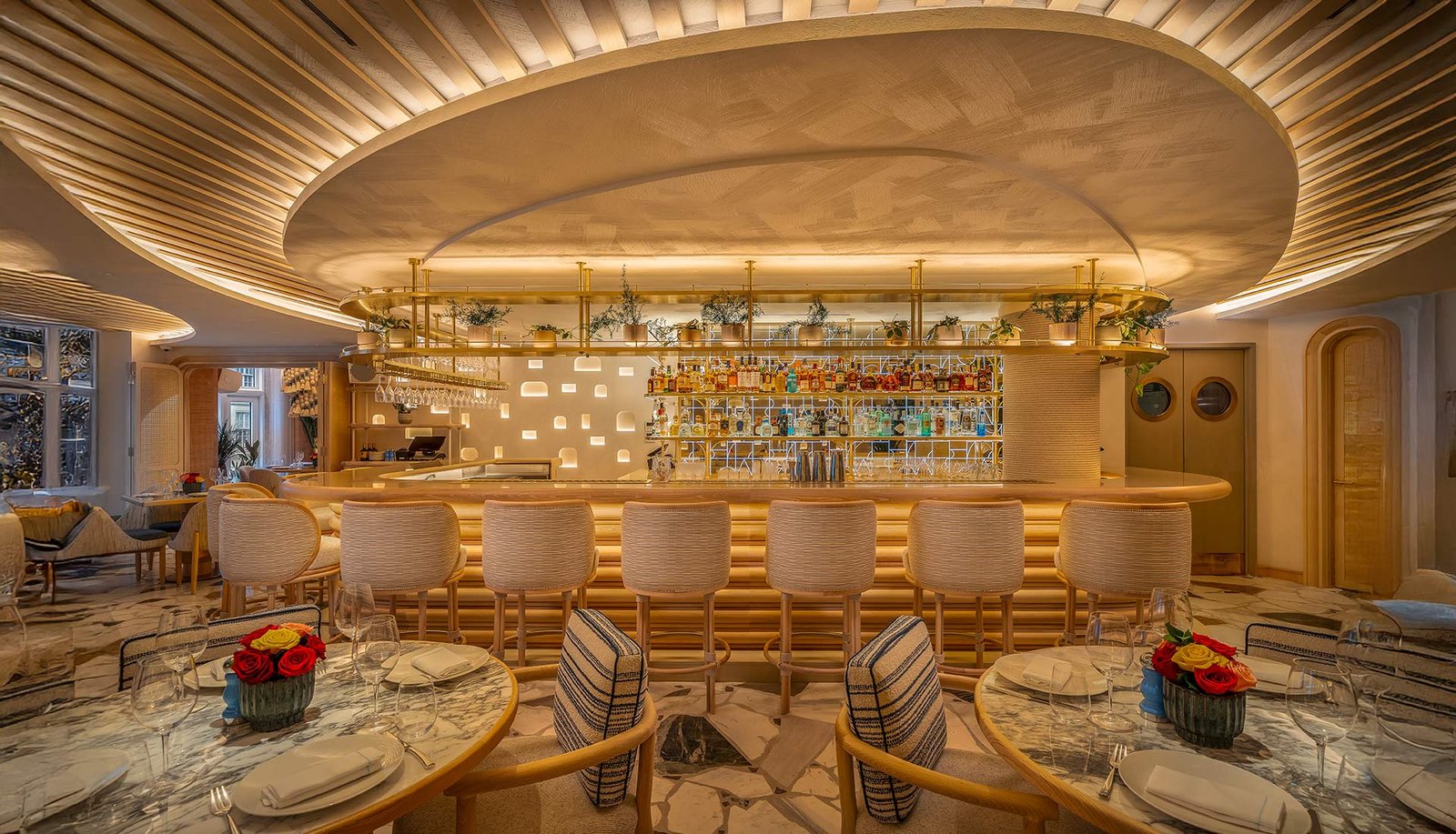
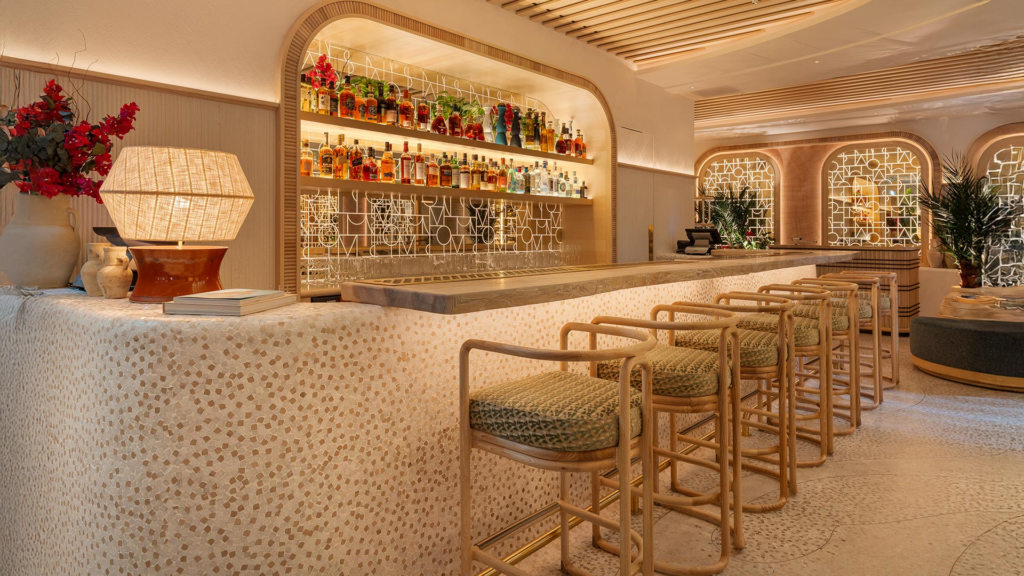
The first thing anyone notices is the bar, and I do not think that is an accident. It sits at the centre of the room rather than off to one side, lit in a way that makes the bottles behind it look worth photographing, as, inevitably, everyone was doing. Around it, the design leans into warm neutrals: beige that never reads as dull, timber that catches the light without straining for effect, tile underfoot that lends the whole space a faint echo of somewhere much further south. It is, unmistakably, high end. But it never once felt cold, which is rarer than it ought to be at this price point.
We were shown to a table close enough to the room’s centre to feel part of things without being on display, and it struck me almost immediately how well the space holds two very different kinds of evening at once. There were couples at quiet two-tops leaning in over candlelight, and there was our table, four or five of us deep into a conversation growing steadily louder, and neither felt out of place. That is a harder trick than it sounds. Most rooms this polished choose a mood and hold it. This one seemed to bend around whoever walked in.
The acoustics helped. Loud enough that no one could eavesdrop on us, quiet enough that we never had to raise our voices to be heard, which after a glass or two in is precisely the balance one wants. Somewhere behind the bar, a playlist worked quietly, never demanding attention, and the whole room carried the hum of a restaurant assured enough not to try too hard.
It was the tile underfoot that stayed with me most, the way it made the room feel warmer than the actual temperature would suggest, a small architectural trick that does considerable, quiet work. Combined with the wood and a persistent, well-judged beige, the effect lands somewhere between a Greek courtyard and a well-appointed drawing room, an unlikely pairing that resolves itself entirely once you are seated within it.
The Drink I Still Cannot Properly Name
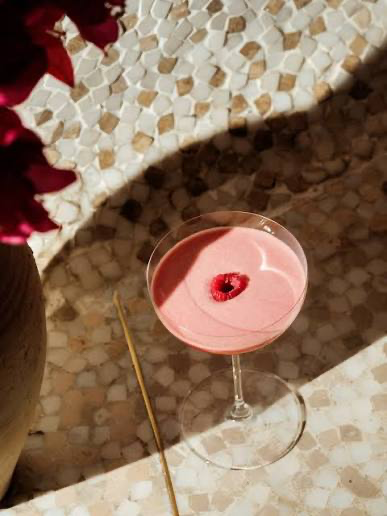
I ordered on instinct, drawn by the mention of lychee and little else. What arrived was a pale pink, faintly floral creation built around lychee, rose and coconut, with what I took to be a note of passion fruit running beneath. I had braced for something cloyingly sweet. It was not. The rose stayed soft rather than perfumed, the coconut rounded the edges without turning the whole thing creamy, and the lychee did what lychee so often threatens and so rarely achieves, tasting genuinely fresh rather than tinned. Balance was the word I returned to. It is not a compliment I extend easily to a pink cocktail with a garnish.
Whoever was behind the bar that night clearly understood their craft, because the drink arrived cold and properly diluted throughout a meal that ran long, never once turning warm and flat in the way cocktails at busy restaurants so often do. I would order it again without hesitation, even without being able to name it with any confidence. Some restaurants might call that a failure of branding. I call it a reason to return and ask.
Whatever Arrives Before You Have Even Ordered
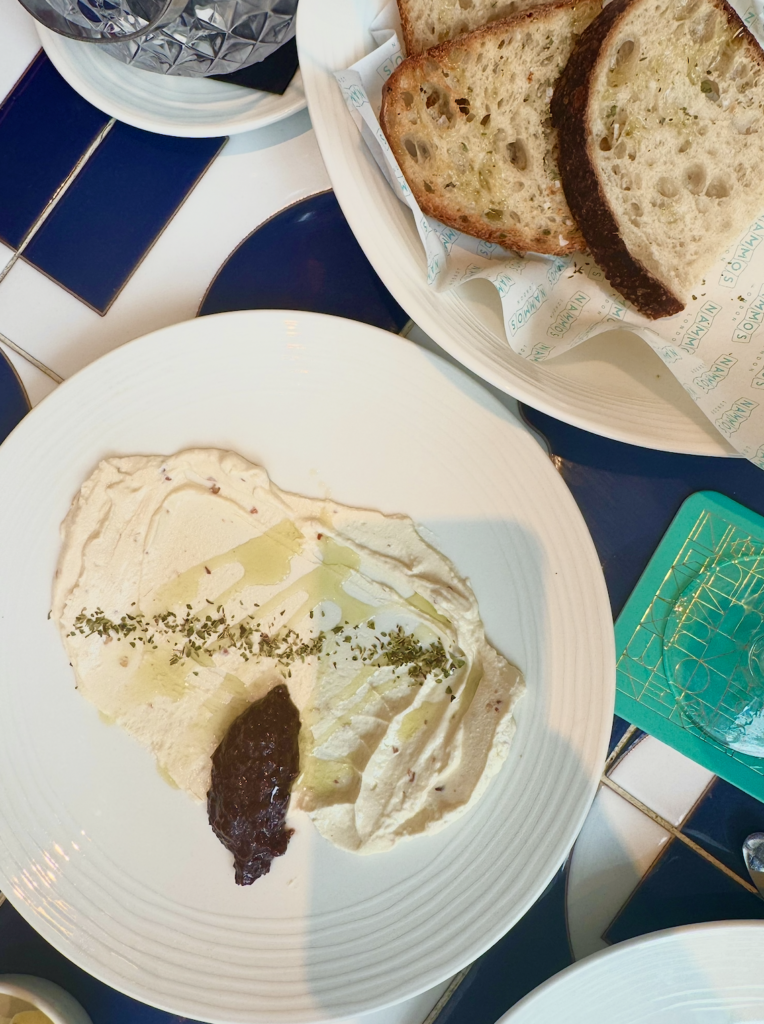
Before we had properly settled into the menu, the kitchen sent out its own idea of a welcome: a whipped feta hummus, cold and thick, alongside warm bread still faintly steaming when torn into, and a scattering of chilli offering more warmth than heat. Beside it sat a tapenade with an unexpected sweetness running through its olive base, the sort of detail that interrupts conversation entirely while you ask the table whether anyone else has just tasted the same thing.
It was a small thing, an amuse bouche we had not asked for and cleared within minutes, but it set the tone for everything that followed. Nothing about it felt like padding ahead of the courses to come. It felt like a statement of intent from the kitchen, made before we had even ordered, and persuasive enough that the bread basket emptied long before the next course arrived. We finished what remained with our fingers once the bread ran out, and no one thought to stop us.
Buttery, Unctuous, and Gone Far Too Fast
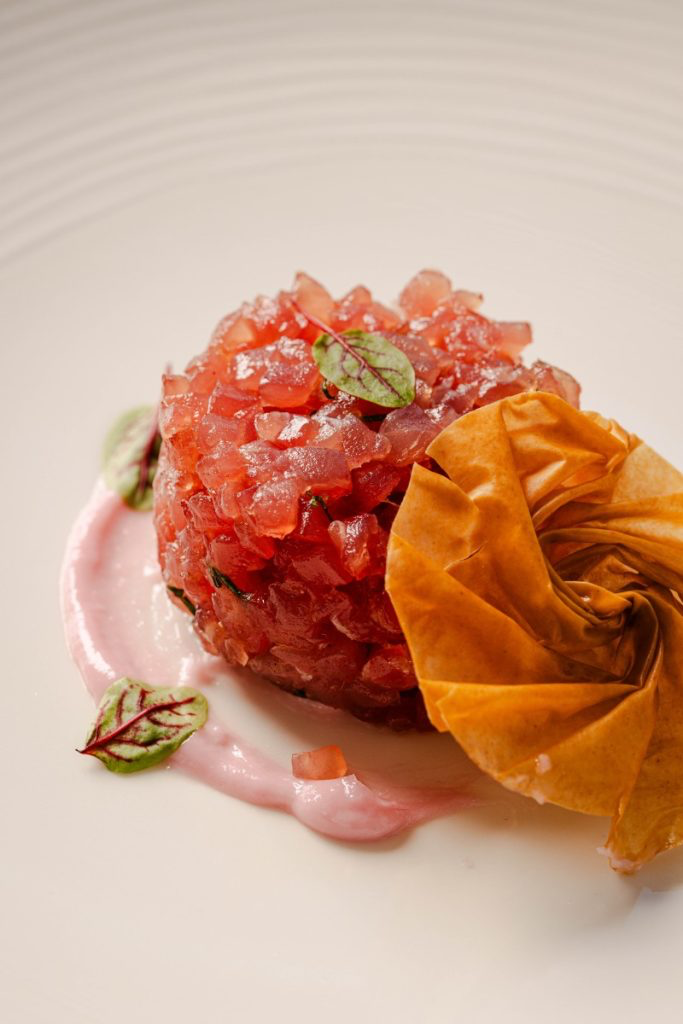
We chose the fish tartare to begin properly, and it may well have been the best thing I ate all night, a claim not easily made on a menu with this much competition. Eel, aubergine, bottarga and mayonnaise, folded together into something far creamier and more indulgent than a raw fish dish has any right to be. The fish itself carried the kind of freshness that announces itself at once, cold and clean against the richness of the mayonnaise, while the bottarga did quiet, saline work in the background rather than dominating the plate.
What I admired most, oddly enough for a starter this indulgent, was how deliberately light it still managed to feel. It is the sort of dish that lets you keep sight of the meal’s end without ever feeling as though you are holding back. We were still discussing it days later, the way one only discusses dishes that have genuinely earned it, and more than one of us arrived independently at the same conclusion: that it vanished from the table faster than anything else we ordered, which at a restaurant this generous with portions is its own kind of compliment.
The Octopus That Fed All of Us
If the tartare was the dish we each privately wished we had ordered twice, the grilled octopus was the one that properly fed the table. It arrived dressed in a Mediterranean sauce of onion, tomato, cucumber and olive oil, the kind of simple combination that succeeds only when every element is properly ripe, and falls apart entirely when it is not. Here, it succeeded. The octopus carried a particular char at the edges that speaks to real attention at the grill, tender enough to yield easily, with the acidity of tomato and cucumber cutting through what might otherwise have been a heavy dish.
A scattering of leaves alongside kept the dish from tipping into excess, which mattered more than I expected given how much else already sat on the table. Portions here were properly generous, enough that everyone received a real taste rather than a polite forkful, and by the time the plate was cleared, conversation had largely stopped, which tells its own story.
Truffle Pasta Lost. The Lobster Linguine Won.
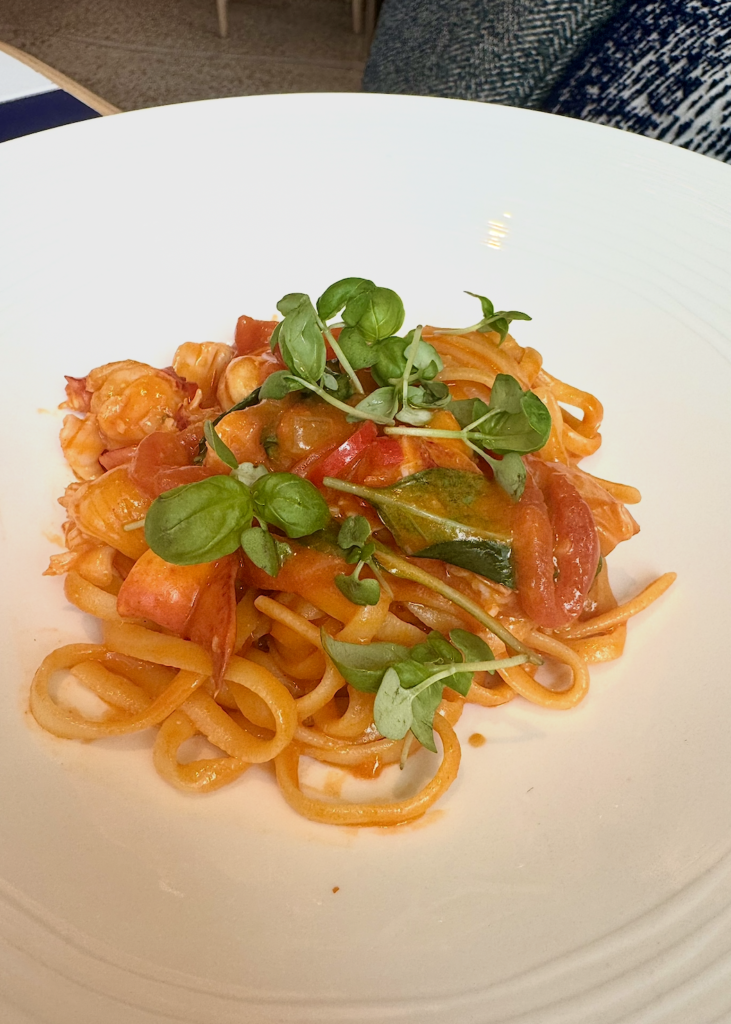
By the time the mains arrived I had moved from my cocktail to something called a Japanese Whisper, a mocktail clean and cool enough to do no harm whatsoever to what followed. We ordered like a table unable to settle on a single direction, which in practice meant choosing two of the classics and sharing both regardless: a truffle pasta and a lobster chilli linguine.
The truffle pasta delivered precisely what it promised, earthy and rich in the way one wants from a dish built around truffle, and on another night, at another restaurant, it might well have taken the honours. Not here. The lobster linguine outclassed it almost immediately, refined enough to let the shellfish genuinely lead rather than disappear beneath sauce, with a chilli heat that built slowly rather than announcing itself all at once. The plate travelled around the table more than once, so that by the end no one quite recalled whose dish it had technically been. For a dish this good, that felt like the correct outcome.
There is a particular silence that settles over a table when a dish exceeds expectation, and the lobster linguine earned exactly that from all of us. Someone reached for the last forkful and another affected not to notice. I did.
Profiteroles, and the Crunch I Was Not Expecting
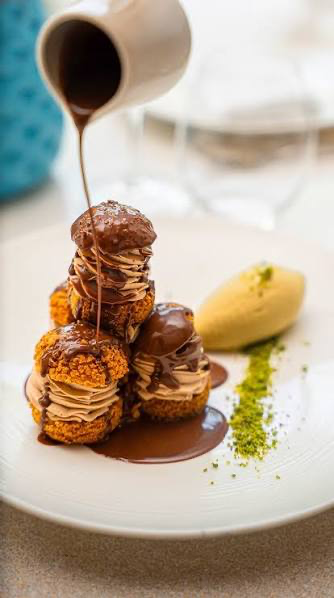
I finished with the profiterole, having saved room for it since the tartare arrived, and it did not fall short of that anticipation. Light, properly creamy in a way choux pastry rarely achieves without tipping into heaviness, with a craquelin shell delivering an unexpected crunch against the softness beneath. It is a small detail, that additional layer of texture, but the sort that separates a good profiterole from a forgettable one, and this belonged decisively to the former.
By dessert we had eased into a slower rhythm, the comfortable, slightly overfull quiet that only follows a meal that has genuinely delivered on its promise. No one was in any hurry to leave, which, given how busy the room had grown around us, felt like a luxury in itself.
What We Missed, and Mean to Return For
We did not get to everything, which on a menu this size feels less like an oversight than an invitation to return. Staff mentioned, more than once, that a teriyaki dish and the house salad were ordered regularly alongside the aubergine mille-feuille, and it was easy to believe them given the conviction with which they said it. There is also a raw seafood counter, we were told, where guests choose their own fish and have it grilled simply in olive oil and lemon, precisely the sort of thing worth building a second visit around rather than squeezing in alongside everything else. We came nowhere near it this time, and I find I mind that very little. It simply means there is a reason to return beyond the lobster linguine, although the lobster linguine, in truth, would be reason enough on its own.
The Kind of Evening It Is Built For
Nammos did not attempt to rebuild Mykonos indoors, and that, I think, is precisely why it works. It borrowed the elements that travel well: the warmth, the shared plates, the sense that a meal is permitted to run long without anyone glancing at their watch, and left the beach precisely where it belongs. Whether one arrives for a date or, as we did, a proper reunion with people seen too rarely, the room seems to know how to hold both without favouring either.
I have already considered who I would bring back and what I might order differently, which is usually the clearest sign a restaurant has done its job properly. The lobster linguine, certainly. The fish tartare, without question. And that pink cocktail I still cannot name, if only to try, once more, to finally catch what the bartender calls it.
Nammos London, 15 Berkeley Street, Mayfair, London W1J 8DY. Booking ahead is advisable, particularly for weekend dinners, and arriving hungry is not optional.