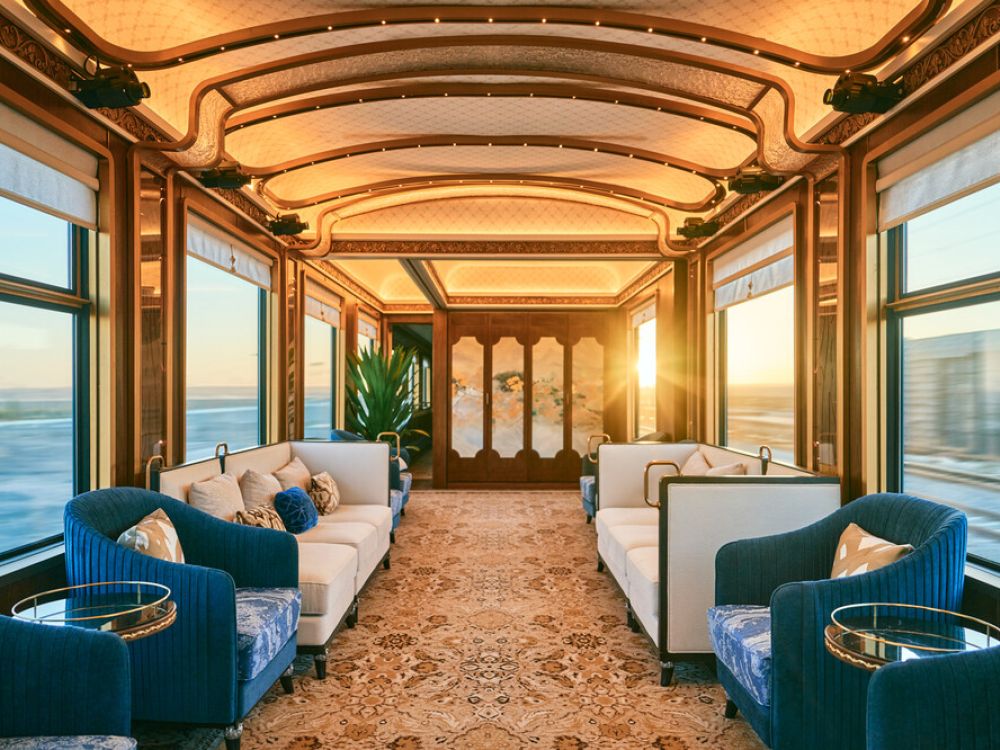
The Golden Eagle Silk Road Express crosses five countries, 3,862 kilometres, and six centuries of history. It is the most ambitious luxury rail departure of 2026.
There is a particular irony in the world’s most talked-about travel trend producing the most overlooked journey of the year. While editorial coverage fills with wellness retreats, hushpitality hotels and curated slow travel weekends in Tuscany, a 22-day private luxury train has quietly launched across one of the most extraordinary landscapes on earth, retracing the ancient Silk Road from Beijing to Tashkent, and the people who know about it are already booking 2027.
Golden Eagle Luxury Trains’ Grand Silk Road journey spans 3,862 kilometres, crosses five countries; China, Kazakhstan, Kyrgyzstan, Tajikistan and Uzbekistan; and features guided excursions at every stop led by specialists from GeoEx, the company’s adventure travel partner. It marks the operator’s return to China and Central Asia for the first time since 2019, with an entirely new train and an itinerary designed around the fact that seven years is long enough to rethink everything. The result is something that rarely exists in luxury travel: a genuinely novel experience without a template, offered by a company with 35 years of knowing exactly what it is doing.
The Journey
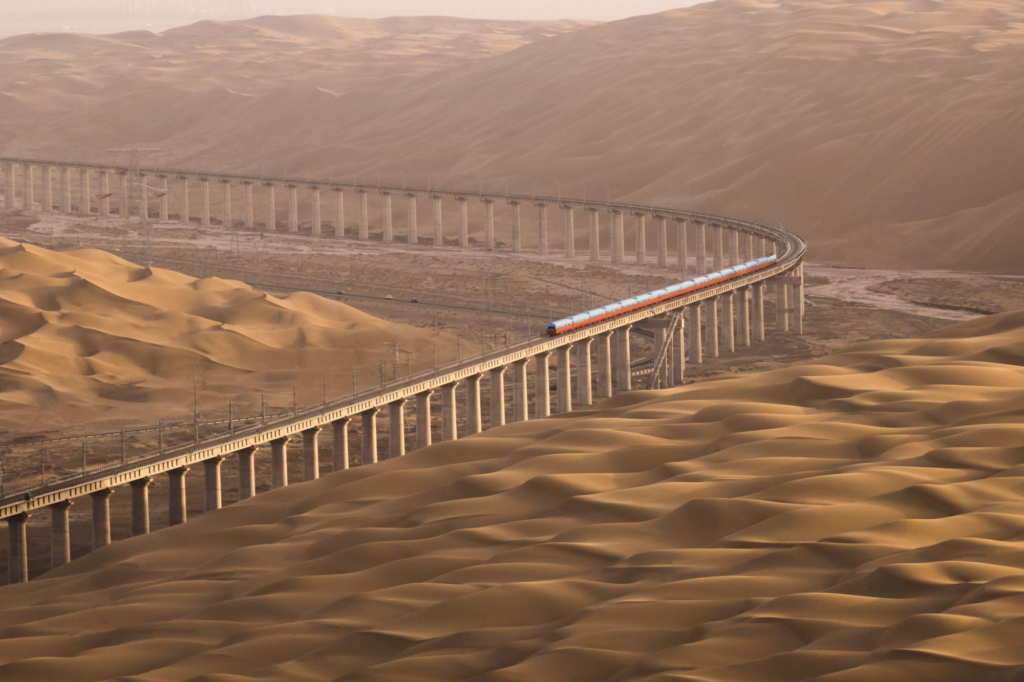
The train departs Beijing, where guests arrive for a two-night stay at the Four Seasons before a welcome reception dinner to meet fellow travellers. What follows is 22 days that move through landscapes most Western travellers have never seen and, in several cases, never considered. The Great Wall. The Terracotta Warriors at Xi’an. The Mogao Caves cut into the cliff-face at Dunhuang. Then the Gobi Desert, crossed on board, the dunes scrolling past the observation carriage windows in the amber light of late afternoon, the scale of the landscape making the train feel simultaneously significant and very small.
The itinerary covers approximately 2,400 miles, passing through desert, ancient cities and UNESCO World Heritage Sites. Between China and Central Asia there is no direct rail link, so passengers take a short flight into Kazakhstan before rejoining the train for the second half of the journey. This is worth knowing before booking, not because it disrupts the experience, it does not, but because it illustrates the ambition involved in making this route work at all. The logistics are extraordinary, and they are entirely invisible to the guest.
Kazakhstan leads into Kyrgyzstan and the dramatic mountain territory of the Tian Shan range. Lake Issyk-Kul, one of the world’s largest alpine lakes, provides a stop that rewards travellers who have been watching desert for days. Tajikistan follows, then Uzbekistan: Samarkand, Bukhara, Khiva, and finally Tashkent. These are not names that appear in mainstream Western travel writing as often as they should. They are among the most extraordinary urban environments in the world: cities where the tilework on a 15th-century mosque will stop a person mid-stride, where the bazaars smell of saffron and dried apricot, where the Silk Road’s historical role as the conduit of human civilisation is visible in the architecture, the food, the shape of the streets. The train is merely the way to get between them.
The Train Itself
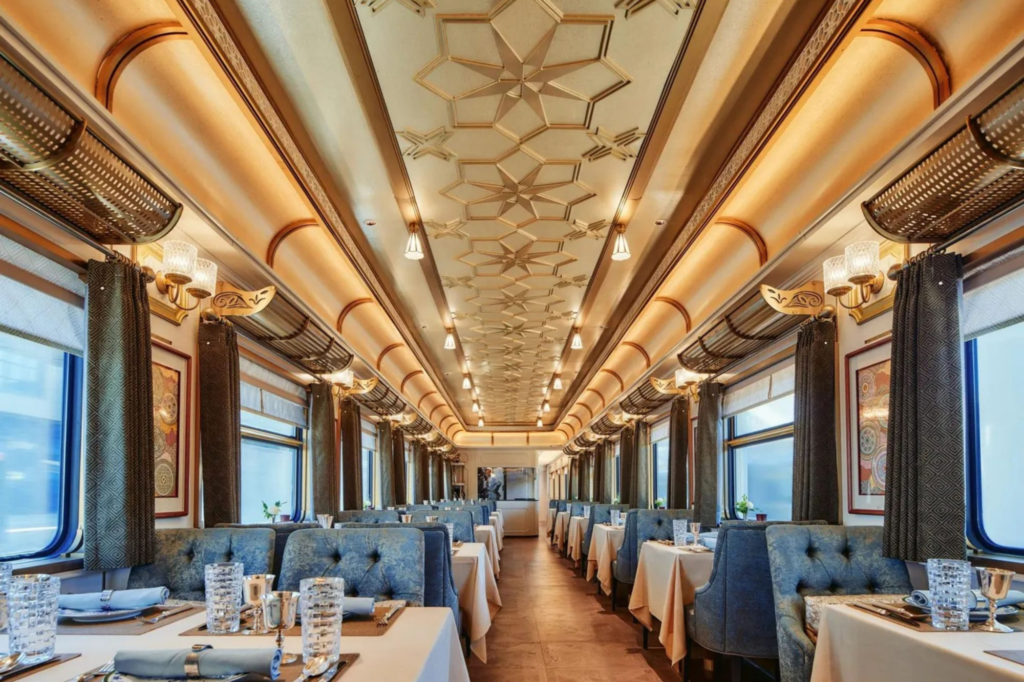
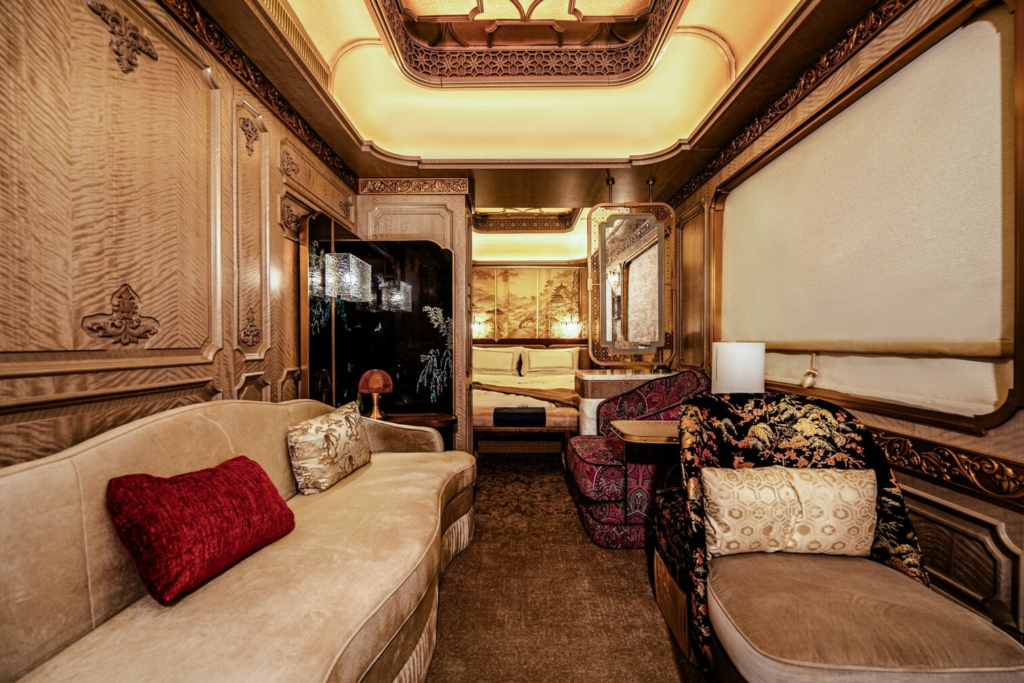
The Golden Eagle Silk Road Express is a purpose-built private touring train, not a converted carriage. The distinction matters. Sleeping carriages are fully en suite, with 24-hour personal cabin attendants, evening turndown service, and premium toiletries. The dining car serves freshly prepared Chinese and international cuisine. The bar lounge car features a baby grand piano, plush sofas and a resident pianist who plays until the last guest leaves. There is an observation carriage, climate control throughout, high-speed Wi-Fi and soundproofing.
The physical experience of travelling this way, rather than flying between cities or joining a group coach tour, is genuinely different in quality from any other mode of transport. The landscape moves at a speed that allows it to be understood rather than glimpsed. Fellow travellers become companions over three weeks in a way that airport lounges and hotel lobbies do not permit. The rhythm of the day, morning boarding after an excursion, afternoon transit, evening arrival, dinner in the dining car, the piano bar until sleep, establishes itself within days and becomes the structure around which everything else is experienced.
Meals are freshly prepared and reflect the regions being crossed: Chinese cuisines in the early days, Central Asian flavours as the journey moves west, alongside a full international menu. The wine list is serious. The bar does not close until the last person is ready to go to bed.
Why 2026 Specifically
The timing of this launch is not arbitrary. Uzbekistan welcomed 1.77 million visitors in the first two months of 2026 alone, a 33% increase year on year, surpassing established markets including Russia, Turkey, China, India and Greece. The luxury infrastructure has been built to support a discerning traveller in Samarkand and Tashkent in a way it simply had not five years ago, when the route last operated. International hotel brands have opened properties in both cities. The restaurant scene in Tashkent has become genuinely interesting. Samarkand’s Registan Square now has the surrounding accommodation and dining infrastructure to sustain a multi-day stay rather than a rushed half-day visit.
The cities at the end of this journey are ready. That readiness is relatively recent, and given the pace at which Uzbekistan is developing as a destination, is unlikely to remain quiet for much longer. The window in which these places feel genuinely discovered; rather than discovered by everyone else; is not closing rapidly, but it is closing.
There is also the question of the landscape itself. The Gobi Desert, the Tian Shan mountains, the Fergana Valley, the salt flats of Turkmenistan; these are not landscapes that compress into a city break or a ten-day fly-drive. They require time, and the train is time made luxurious. The slow travel premise that runs through so much of 2026’s editorial conversation finds its fullest expression not in a Cotswolds country house or a Sardinian villa, but here, on a private train crossing the oldest trade route in human history.
The Practical Reality
Prices start at $50,700 per person based on double occupancy. At 22 days all-in, with expert guiding, private luxury rail accommodation, pre- and post-journey hotel stays, all food and beverages and comprehensive excursion programmes, the daily rate is less alarming than the headline figure. It is still, without question, a significant expenditure. The journey is pitched at travellers for whom the experience itself, rather than the destination’s name recognition, is the primary motivation.
The inaugural departure runs from 21 September to 12 October 2026, with a second journey planned for 30 August to 22 September 2027. There is one departure in 2026. It is not a journey that can be rescheduled around a convenient gap in the diary. The waiting list for 2027 is already forming.
The group size is deliberately limited, which means the experience feels private rather than packaged, and the guiding is genuinely personalised rather than broadcast to a crowd. GeoEx specialists lead excursions at every stop, and the depth of local knowledge on offer is of a different order from anything a general touring company can provide.
For the luxury traveller who has been to Japan, Italy, the Maldives, the Amalfi Coast; who has stayed in the relevant hotels and eaten at the relevant restaurants and returned with the photographs and the memories and the slight sense that the loop is becoming closed; this journey offers something that cannot be manufactured by adding a private chef to a villa. It is a genuinely unfamiliar landscape, experienced in a genuinely unusual way, with time to understand both.
The Grand Silk Road by Golden Eagle Luxury Trains departs 21 September 2026. Prices from $50,700 per person based on double occupancy, including hotel nights in Beijing and Almaty, all meals and drinks, guided excursions and onboard medical support. goldeneagleluxurytrains.com