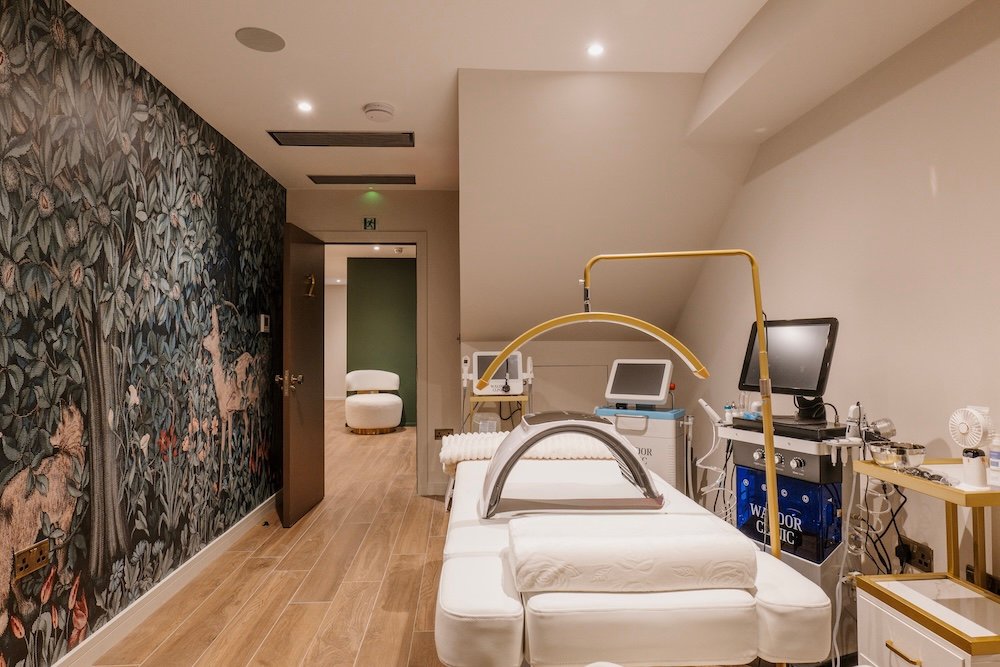
I came to Marylebone with one rule, no needles under any circumstances, and left with a firmer jaw, a tighter neck and a new respect for ultrasound.
Somewhere in my early thirties, my face started changing faster than I could keep up with. Nothing dramatic happened. My jawline just got softer around the edges, a faint slackness showed up under my chin in certain photos, and my skin seemed to need two good nights’ sleep to recover from one bad one. The obvious answer, the one half of London seems to have reached for, is a syringe. A little Botox here, a little filler there, a tweakment booked between lunch and the school run.
I am not that woman. Not because I judge anyone who is, but because I am, quite simply, unnerved by needles. The mere sight of one is enough to undo my composure. So for the past few years I have run my own quiet experiment: trying every needle-free treatment I can find, to see how far you can get with technology, good skincare and the right hands. Lasers, peels, radiofrequency, LED, more facials than I could count. Some were lovely and did nothing. A few were worth every penny.
And HIFU had been on my list for a long time…
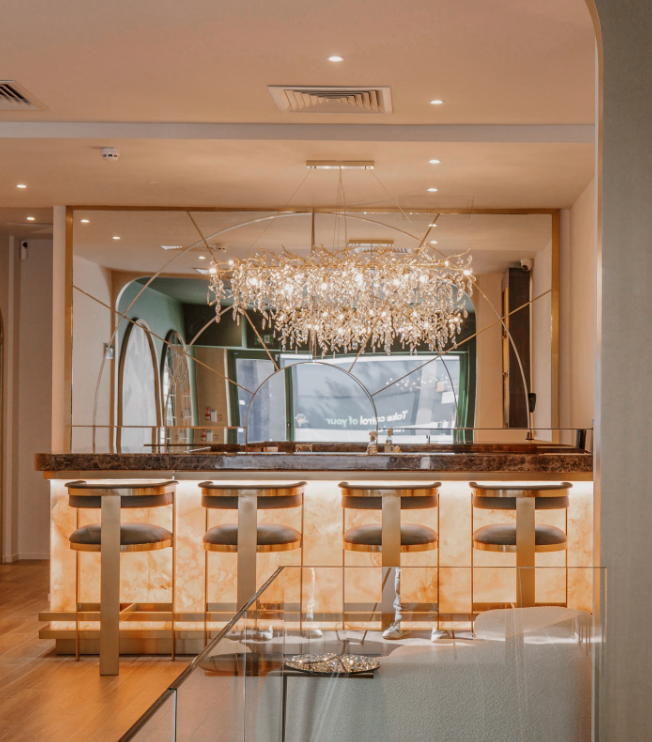
Waldor Clinic sits on Great Portland Street, a few minutes’ walk from Oxford Circus, which, if you know that stretch of London, speaks volumes about what lies behind its front door. Outside: shopping bags, buses, tourists stopping dead on the pavement to check their phones. Inside: silence.
I mean that almost literally. The door closes and the noise of the West End simply stops. What replaces it is a palette of deep greens and soft gold, curved furniture with no hard corners anywhere, and the kind of low, flattering light that makes you feel better about your skin before anyone has touched it. It feels less like walking into a clinic and more like stepping into another world, one that has been designed by somebody who understands that most people arrive at an aesthetics clinic slightly nervous.
I was one of them. I sat down on a sofa so curved it felt like being held, and I noticed my shoulders drop for the first time that day.
What I appreciated, and I don’t say this about many clinics, is that the space manages to be both clinical and warm at once. It is spotless. You can tell the treatment rooms are serious places where serious technology lives. But nothing about it is cold or sterile. The design does the work of reassuring you, leaving the team free to focus entirely on you.
Ultrasound, a cancer ward and the SMAS layer
Before I go any further, a quick word on what HIFU actually is, because I had only the vaguest idea before my appointment.
High-Intensity Focused Ultrasound started life in medicine, not beauty. Doctors have used focused ultrasound for years in serious settings, including certain cancer treatments, because it can deliver energy precisely to a point beneath the surface without cutting into the skin. The aesthetics world borrowed the idea and turned it towards something far less grave: lifting faces.
Here is how it works. The device sends concentrated ultrasound energy through the skin to very specific depths, including the SMAS layer, the same deep structural layer a surgeon tightens during a traditional facelift. At those focal points, the energy creates tiny zones of heat. Your skin’s surface is left alone, but underneath, your body reads those little points of heat as an injury to repair. Its response is to produce new collagen and to contract and bind the existing tissue together more tightly.
This is why people call HIFU a non-invasive facelift. Nobody is cutting, lifting and stitching. Your own body does the rebuilding, from the inside out, over weeks.
At Waldor, the device is a Korean multi-dimensional system, often referred to as 23D HIFU, which works across several depths of skin rather than just one. The clinic is particular about its technology. The machines are bespoke, and when a newer, updated version of a device comes out, they bring it in. I liked hearing that. In a field where the gap between an old machine and a new one can be the difference between results and disappointment, it matters.
Meeting Marsi, and the analysis that changed my skincare
My practitioner was Marsi, and I want to say from the outset that she took exceptional care of me. Calm, precise, kind in a way that never tipped into fussy. Within about two minutes I trusted her completely, which, for someone with my aversion to needles, is no small feat.
We started with a skin analysis, and this is where Waldor first showed me what kind of clinic it is. Using an AI-assisted scanner, Marsi mapped my skin: hydration, laxity, texture, the areas starting to lose their firmness. Seeing your own face broken down on a screen is humbling. Seeing it explained properly, by someone who actually wants you to understand it, is genuinely useful.
I learned more about my skin in that conversation than I had from years of buying serums on instinct. Which products suit my skin, which ones I was probably wasting money on, why my jawline was the area where I’d see the most difference.
What struck me most was how tailored everything was. Waldor’s philosophy is that there is no one-size-fits-all approach. Marsi walked me through how the clinic thinks about skin at different ages, and it was the clearest explanation I’ve heard anywhere.
For women in their mid-twenties, the clinic tends to recommend its signature HydraGlass facial as a starting point. It is a gentle introduction: you learn about your skin during the analysis, you learn about the products, and you build good habits before you need anything more serious. It has also had real success with acne. For those dealing with acne scarring, the clinic moves into lasers, including CO2 and resurfacing lasers, combined with analysis and a prevention plan so the problem doesn’t simply return.
Between thirty and forty-five, microneedling comes into play, and Waldor’s version is different from what you will find in most places. They pair it with peptides from Korea to which the clinic holds exclusive rights. These are formulated to be delivered just beneath the surface of the skin, where they can actually do their job, rather than sitting on top of it. (Yes, microneedling involves needles, albeit very fine ones. I am working up to it.)
And from thirty upwards, HIFU becomes the hero treatment for anyone who wants lift and firmness without going near a scalpel or a syringe.
Beyond that, the menu covers the full range: lasers, resurfacing, acne scarring, wrinkles, all of it approached in a personalised, custom way. Nothing on the menu is sold to you because it’s the treatment of the month. Marsi was very clear that her recommendations depended on my skin, and nothing else.
No hard sell, just a perfectionist streak
It’s worth dwelling on this for a moment, because anyone who has spent time in central London aesthetics clinics will know how rare it is.
Many clinics in this part of town are, frankly, sales operations with treatment rooms attached. You go in for one thing and walk out having been “advised” to book three others, plus a course, plus a membership. At Waldor I felt none of that pressure. If anything, the opposite: the sense that they would rather tell you not to have a treatment than sell you one you didn’t need. I later read that this is something their clients mention again and again, and I’m not surprised.
What they care about is the result. You can feel it in every conversation. The transformation genuinely seems to matter to them more than anything else, and they approach each treatment like perfectionists. This is one of the rare clinics where I truly felt the team wanted to give me the best possible outcome, not the most expensive one.
That changes how you experience the treatment itself. When you trust that the people in the room are on your side, you relax. And when you relax, you can make peace with whatever comes next, including a bit of discomfort.
Cleanse, gel, and then the clicks begin
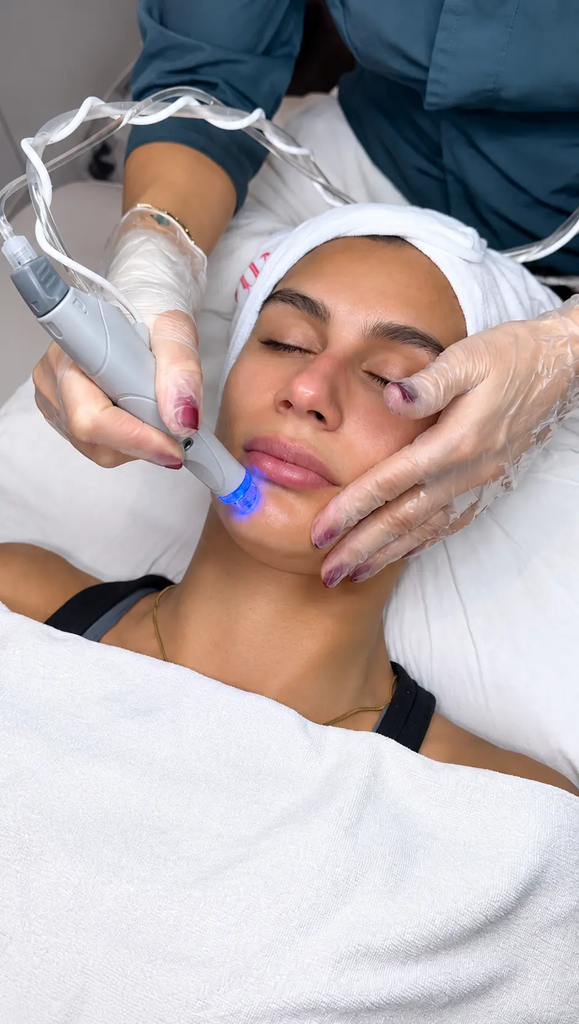
Here is how my HIFU treatment unfolded, step by step.
First, Marsi cleansed my skin thoroughly. This isn’t the quick wipe you get before some treatments. She took her time removing every trace of makeup, oil and sunscreen, because the ultrasound needs clean skin to work properly and evenly.
Next came the gel. A cool, clear layer smoothed over my face, jaw and neck, the same kind used for a pregnancy scan. The gel lets the ultrasound energy travel cleanly from the device into the skin. I’ll admit there’s something oddly comforting about it: it feels like a medical procedure in the most reassuring sense.
Then the device. Marsi worked across my face in a methodical pattern, placing the handpiece against my skin and passing it along in neat lines. With each pass you hear a series of small clicks, and with each click comes a pulse of energy deep under the surface. On my cheeks and forehead, it felt like a warm, prickly tingle. Very bearable. I began to wonder why I had hesitated for so long.
Then she reached my jaw.
I want to be honest here, because I think too many reviews skip over this part. The jawline hurt. I don’t consider myself particularly sensitive to pain, and it still made me catch my breath. It isn’t a sharp pain, more a deep, dull ache, as though someone were pressing firmly on the bone from the inside. It comes in short bursts, so you never have to sit with it for long, and Marsi checked in with me constantly. But if you are expecting a facial, you should know this isn’t one.
That is something Waldor is quite open about: their treatments are not here to relax you. They are here to deliver results. There are plenty of beautiful spas in London where you can drift off under hot towels. This is not that, and it doesn’t pretend to be. I respected that honesty more than I can say.
The neck was easier than the jaw, and before I knew it, the HIFU part of the treatment was done.
Then came the HydraGlass, and I forgave everything
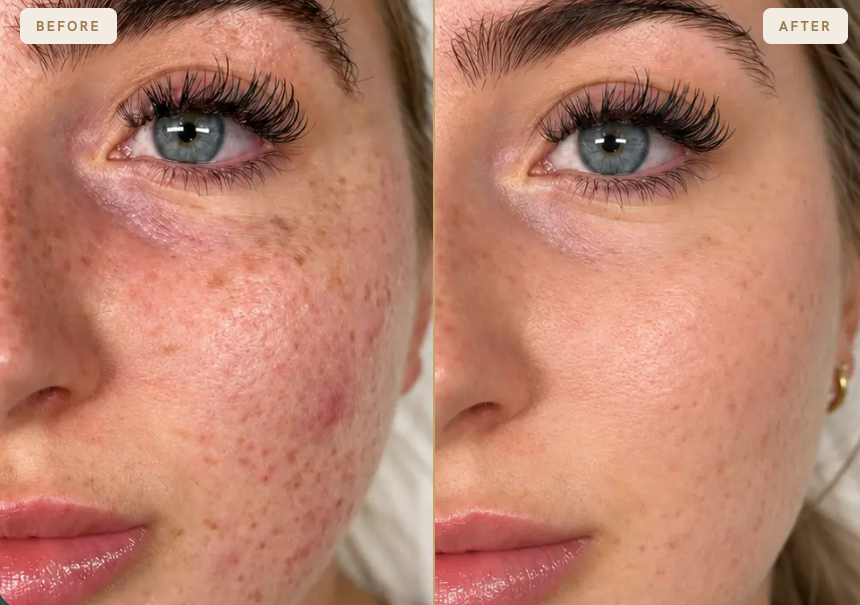
Once the HIFU was finished, Marsi added the clinic’s signature HydraGlass facial. After the intensity of the ultrasound, it felt like a reward.
The HydraGlass works in stages, starting with a deep cleanse and gentle exfoliation to lift away dead skin cells and reveal the fresher skin underneath. Next comes a light peel to loosen whatever is sitting in the pores. Then, using a gentle vortex suction, the device draws out impurities and congestion, painlessly and with none of the red, angry aftermath of a traditional extraction. Finally, it infuses the skin with hydrating serums, flooding it with moisture so it looks plump and dewy, before a soothing finish to calm everything down.
After the ultrasound, it was exactly what my skin needed: cool, calming and quietly restorative. It also meant I left looking luminous rather than like someone who’d just had a medical treatment on her face. If HIFU is the long game, HydraGlass is the instant gratification, and pairing the two is an inspired combination. Many of Waldor’s clients do exactly that, and now I understand why.
The whole appointment, from analysis to the final layer of serum, lasted ninety minutes. Not a single one of them felt rushed. This is where Waldor sets itself apart. Its care is meticulous, and it shows in the small things: the extra minutes spent explaining, the constant checking in, the way Marsi never once made me feel like the next client was waiting.
The week after: a dull ache and a little puffiness
Let me be precise about recovery, because this is the part people actually want to know.
There is no real downtime. I could have gone straight back to my day, and nobody would have guessed I’d had anything done. My skin felt firm immediately afterwards, almost taut, which was a strange but pleasant sensation.
For about two to three days, my face felt a little puffy. Not swollen, not visibly, just a sense of fullness when I touched my cheeks and jaw. Then it settled.
The jaw is the part to prepare for. I had a dull ache along my jawline for around a week, the kind of tenderness you notice when you chew something firm or rest your chin in your hand. It never stopped me doing anything, but it was there, and I’d rather you knew in advance than were caught off guard.
The aftercare is simple: for 24 to 48 hours afterwards, keep away from heat (no saunas, hot yoga or steaming baths), be gentle when cleansing, and skip anything harsh in your skincare routine. No acids, no retinol, no scrubs. Let the skin do its quiet work.
Week two: the real results appeared
What few people mention about HIFU is that it rewards patience. Your skin takes around six to eight weeks to fully heal and remodel, and that is when you see the full results. Collagen doesn’t rebuild itself overnight.
So I went in with low expectations for the first month. I was wrong.
By week two, I could already see a difference, and it wasn’t subtle. My jawline looked sharper and beautifully defined, in a way I hadn’t seen in a couple of years. My skin felt firmer to the touch and looked clearer. And the change I hadn’t dared hope for: the slight sagginess in my neck, the area I had begun discreetly angling away from the camera, had gone.
It looks like a small lift. A mini facelift, if you like, but without any of the inconvenience that comes with a real one: no needles, no scalpel, no bruising, no weeks of hiding at home. Just my own face, a little tighter and fresher, as though I’d had six months of very good sleep.
The results of HIFU typically last between six and twelve months, after which a single top-up session maintains the effect. For a needle-free treatment, that’s a long time.
What I’d tell a friend before booking
In fairness, HIFU isn’t for everyone, and it’s not instant. If you want a dramatic change in an afternoon, look elsewhere. If you have a low pain threshold, be prepared for the jawline. And as with any HIFU treatment, the real proof comes with time; the results build gradually rather than all at once.
But if you’re in your thirties or beyond, you want firmer, more lifted skin, and you don’t want injectables anywhere near your face, this is one of the most convincing alternatives I’ve tried. And Waldor is the clinic I’d send you to.
Not because of the gold-and-green rooms, lovely as they are, or even the Korean technology, impressive as it is. I’d send you because of the way they treat you. From the analysis to the aftercare, every person I met seemed invested in my results, honest about what to expect and unwilling to sell me anything I didn’t need.
There’s a particular kind of calm that comes from knowing you’re in genuinely good hands. At Waldor, I found it in the unlikeliest place: on a treatment bed, mid-click, with ultrasound pulsing through my jaw.
Two weeks later, I still catch my reflection and look twice, in the most flattering sense.
Practical information
Where: Waldor Clinic, Great Portland Street, Marylebone, London. A few minutes’ walk from Oxford Circus.
Treatment: Korean 23D HIFU, face and neck, combined with the signature HydraGlass facial. Around 90 minutes, including skin analysis.
Price: HIFU from £349 to £895 for larger areas
Downtime: None. Expect mild puffiness for 2 to 3 days and a dull ache along the jaw for about a week. Avoid heat, harsh skincare and vigorous cleansing for 24 to 48 hours.
Results: Visible from around two weeks; full results at 6 to 8 weeks; lasting 6 to 12 months.
How to book: Via the Waldor Clinic website or by phone.