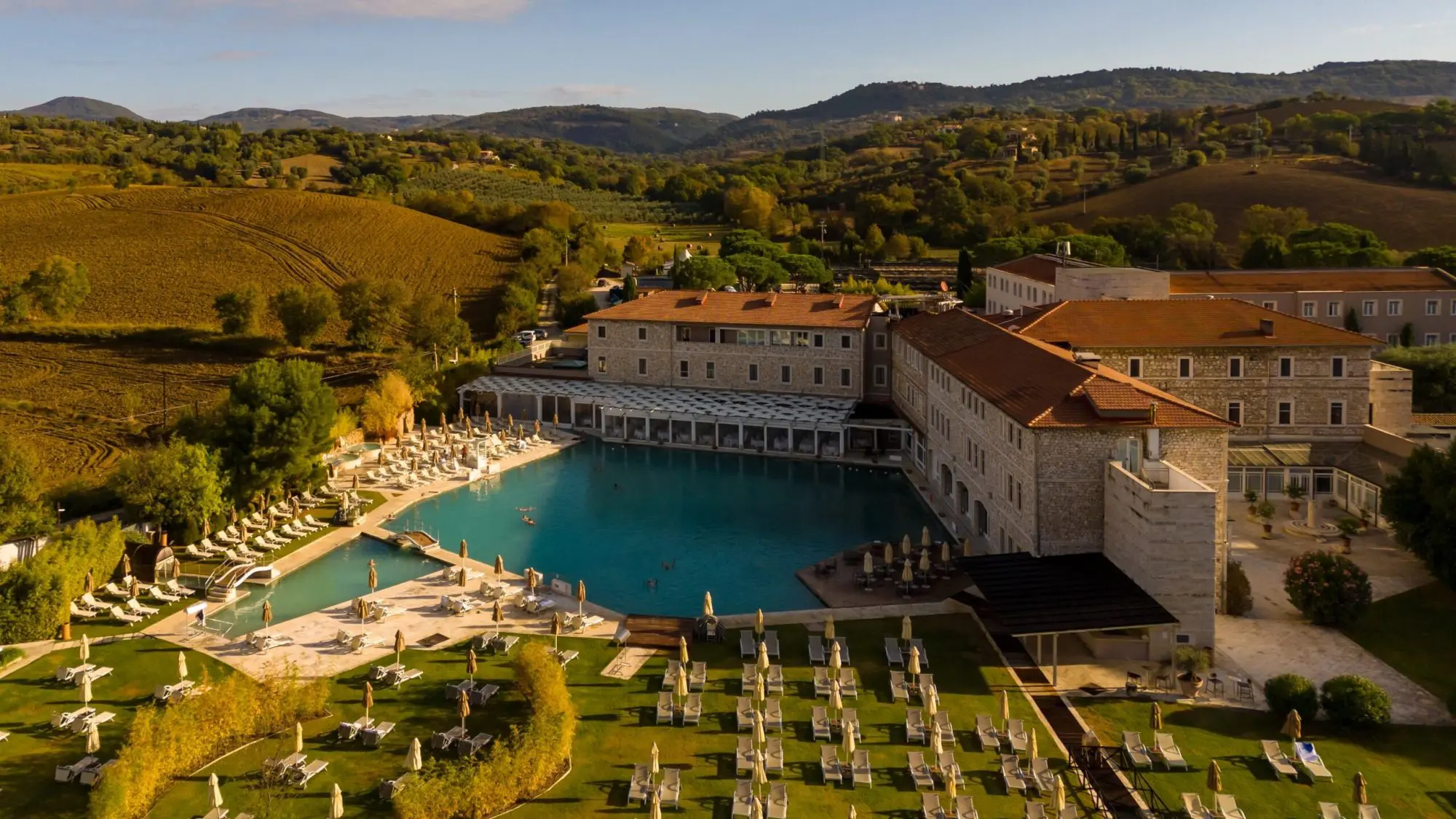
At this legendary Maremma retreat, the treatments are almost beside the point; it’s the water that does the real work.
There are places that earn their reputation through relentless PR and places that earn it through 3,000 years of uninterrupted geological proof. Terme di Saturnia belongs firmly to the second category. The water that feeds its pools has been flowing out of Monte Amiata at a steady 37.5 degrees Celsius since long before anyone thought to build a hotel around it, and standing waist-deep in the vast steaming reservoir on a cool Tuscan morning, watching the mist roll across olive groves and the Maremma’s fortified stone hill towns in the middle distance, it is entirely believable that Roman legions used to drop by here on the march home from battle. The logic is irresistible. You arrive tight-shouldered and slightly suspicious of all the wellness language, and within twenty minutes you are loose and warm and thinking about nothing in particular. That is the effect. It is not subtle, and it doesn’t need to be.
The resort itself sits in the southernmost corner of Tuscany, in the Maremma, a region that most international travellers skip in favour of Chianti and Florence and Siena. This is their loss and your gain. The landscape here is wilder and less choreographed: long views across pasture and scrubland, medieval villages perched on volcanic tufa rock, the smell of warm earth and pine. Terme di Saturnia occupies its own pocket of this countryside, five-star in its offerings and genuinely unhurried in its pace, which is a combination that requires more confidence to pull off than it might seem.
Blood-Warm and Sulphurous, Which Sounds Worse Than It Is
The Roman god Saturn, so the legend goes, hurled a lightning bolt into a volcanic crater in a moment of impatience, releasing a continuous stream of healing water that has flowed freely ever since. Whether or not you are inclined toward mythological origin stories, the practical result is impressive: water that the Italian government’s own scientific assessments describe as antiseptic, anti-inflammatory, antioxidant, skin-buffing, blood pressure-lowering, and an antidote to water retention. It also smells faintly of sulphur, which takes about ten minutes to stop noticing. After that, you stop noticing most things.
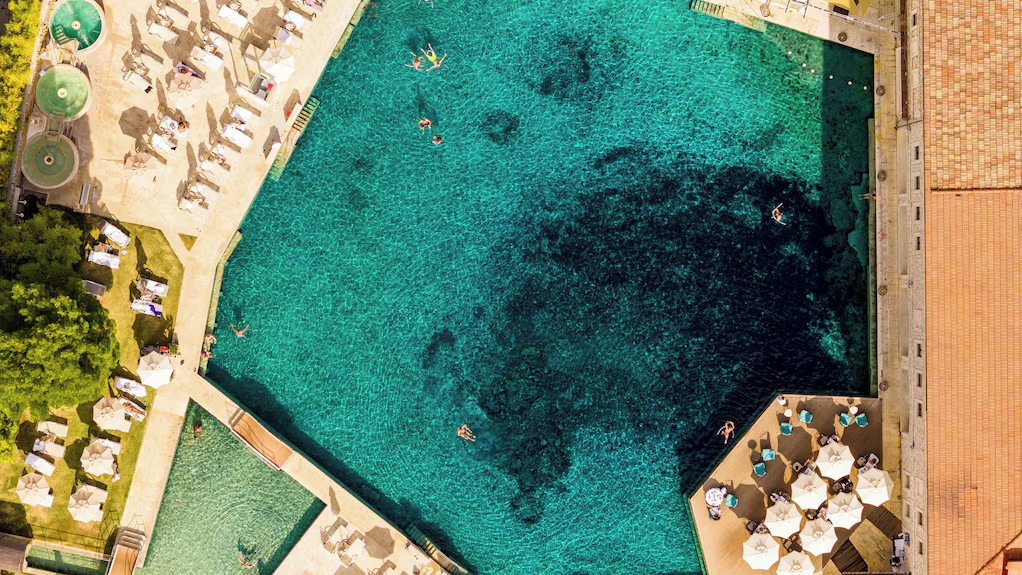
The five thermal pools are the anchor of everything here. The largest is the healing reservoir, a steaming expanse where thermal plankton floats in visible, slightly alien-looking clusters — a gelatinous seaweed-like substance harvested directly from the water and used as a key ingredient in the resort’s signature treatments. It sounds peculiar. It feels extraordinary. The water temperature holds at that body-matching 37.5 degrees year-round, which means the experience in winter, when cold air meets hot steam in theatrical clouds above the pool, is entirely different from summer, when the surrounding countryside is bone-dry and golden and the whole scene takes on something almost cinematic. Both are worth the trip.
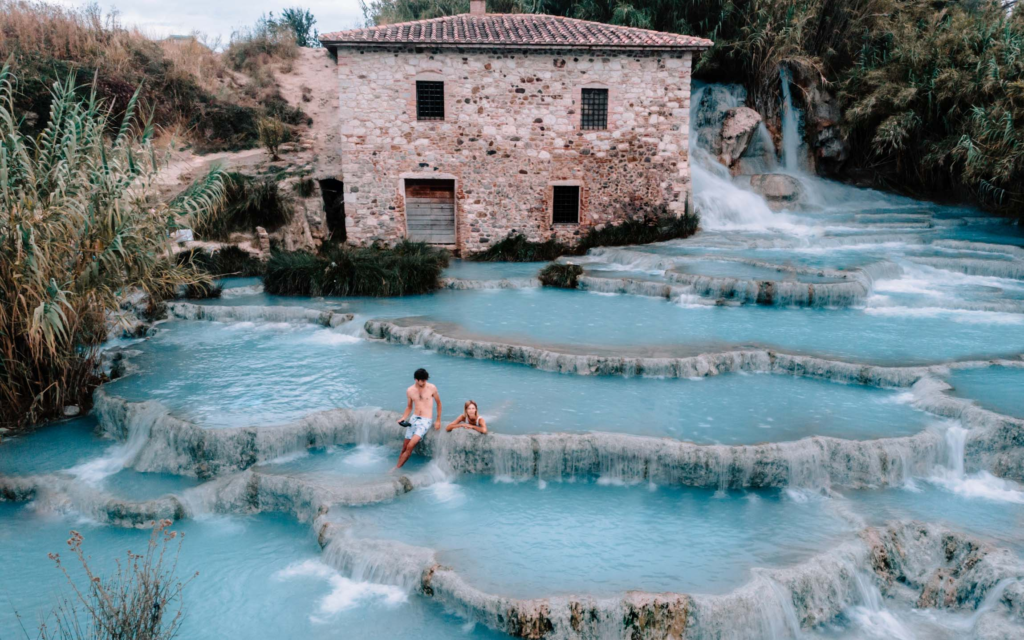
For those unable or unwilling to wait for a resort booking, the Cascate del Mulino just outside the property offers the same thermal waters for free, tumbling over natural travertine terraces into open-air pools. Italians from across the country make the pilgrimage. It is considerably less serene than the hotel pools, considerably more joyful, and worth an afternoon regardless of where you are staying.
The Terme di Saturnia Method, Which Is Largely an Excuse to Be in Water
The resort’s wellness philosophy builds from the thermal waters outward. Balneotherapy; the therapeutic bathing itself; is combined with nutritional advice, naturopathy, mindful eating and movement, with programmes running from three to seven days or more. The menu of retreats covers classic relaxation and detox, tailored weight management, anti-ageing, mindfulness and mental health, each customised around the individual. At the heart of most programmes is fango therapy: a warm therapeutic mineral clay applied as a full-body treatment. Minerals absorb through the skin, circulation improves, the body sweats out what it doesn’t need. It is earthy in the most literal sense and completely convincing.
What distinguishes the Saturnia approach from the more punishing end of European wellness is an almost Italian refusal to make the whole thing miserable. There are no cold-turkey periods, no mandatory silence policies, no 5am wake-up calls presented as a gift to the nervous system. Movement here tends to involve considerable amounts of gentle paddling in thermal water, occasionally accompanied by idle conversation with a stranger from Milan who has been coming for fifteen years and will give you very good restaurant recommendations for the drive home. This is entirely by design, and it is the right call. Wellness enforced through deprivation tends to produce a very specific kind of exhausted resentment. The Saturnia version produces the other thing.
Laura Quinti Reads the Iris
The resort’s standout practitioner is Laura Quinti, a naturopath whose client history includes Roman Abramovich and the Chelsea Football Club medical team, which is either a recommendation or a talking point depending on your perspective. She offers iridology consultations; a reading of the iris for signs of constitutional imbalance; alongside psychophysical health work through alternative therapies. One of her tools is the monochord, a single-stringed instrument whose sustained vibrations produce a deep meditative state that she uses as a pathway into hypnotic relaxation and, she claims, considerably better sleep. Whether you arrive as a committed sceptic or entirely open to what she is offering, the quality of rest that follows a session with Quinti tends to land somewhere between surprise and mild embarrassment at how effective it was. She is also notably practical in conversation about what the body actually needs versus what the wellness industry would like you to spend money on. Book her.
An Excellent Dining Room, Which Mattered Before Any of This
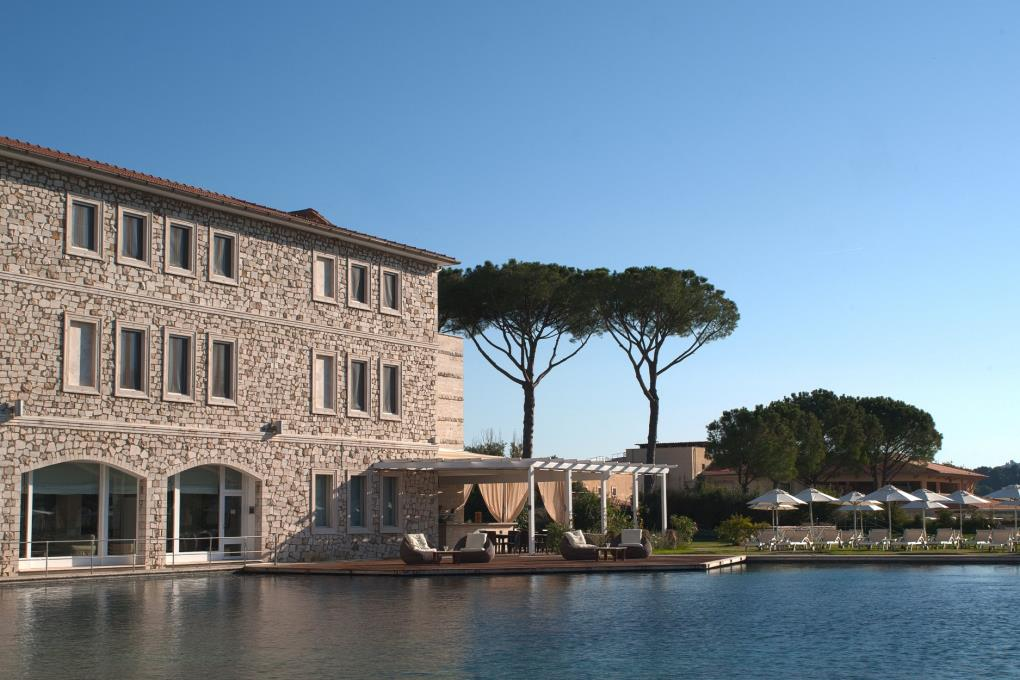
The original Ciacci family facility dates from 1864 and became a formal hotel in 1919, at which point it was rather better known for its kitchen than for its waters. A century on, the dining room has not forgotten this. Eating here involves local olive oil that has nothing in common with the supermarket version, wine from the surrounding Maremma vineyards — Morellino di Scansano if you take any interest in Sangiovese, and you should — and the kind of cooking that makes the medicinal framing of a spa retreat seem almost like a secondary concern. Nobody will stop you having a glass of wine. Nobody will suggest you replace it with a green juice. This is Italy, and the food is understood as part of the cure rather than a departure from it. There are, apparently, bowls of chocolates and jellies in reception, and guests who require a nicotine break take it in the garden without apology. The spirit of the place is not self-flagellation.
Hill Towns, E-Bikes, and No Particular Schedule
The surrounding countryside is accessible on complimentary e-bikes, which is one of the better ideas the resort has had. The Etruscan hill towns within cycling distance — Pitigliano, Sorano, Sovana — belong to a different era in the best possible way. Pitigliano in particular, built on a promontory of volcanic tufa with its medieval towers and dramatic ravines, has the quality of a place that shouldn’t still exist and does anyway. Arriving there with thermal-relaxed limbs, no deadline, and the particular appetite that seems to come with a morning in warm sulphurous water, is a specific pleasure that resists adequate description and does not require it. Go. You will understand immediately.
What Remains After You Leave
For two or three days after returning from Terme di Saturnia, the skin retains a particular softness and the shoulders stay noticeably lower than usual. This is either the documented scientific result of extended thermal bathing or the simple consequence of having spent several days doing almost nothing useful in warm water in the Tuscan countryside. Either way, the effect is real and it lasts. This is not a spa that presents wellness as competitive suffering or asks you to earn your relaxation through inconvenience. It is one that understands that the body, given the right conditions and sufficient time, will largely sort itself out. The Romans knew this. The Ciacci family formalised it in 1864. Terme di Saturnia has been quietly proving the point ever since, and it shows no signs of stopping.
Practical Information
Terme di Saturnia, Via della Follonata, 58014 Saturnia, Grosseto, Tuscany, Italy. Programmes from three nights; individual spa days available. Day spa and medi-spa treatments bookable separately from room packages. Five-star hotel with full-service spa, golf course and five outdoor thermal pools. The Cascate del Mulino waterfall and public thermal pools are a short drive from the resort and free to access. Book via termedisaturnia.it.