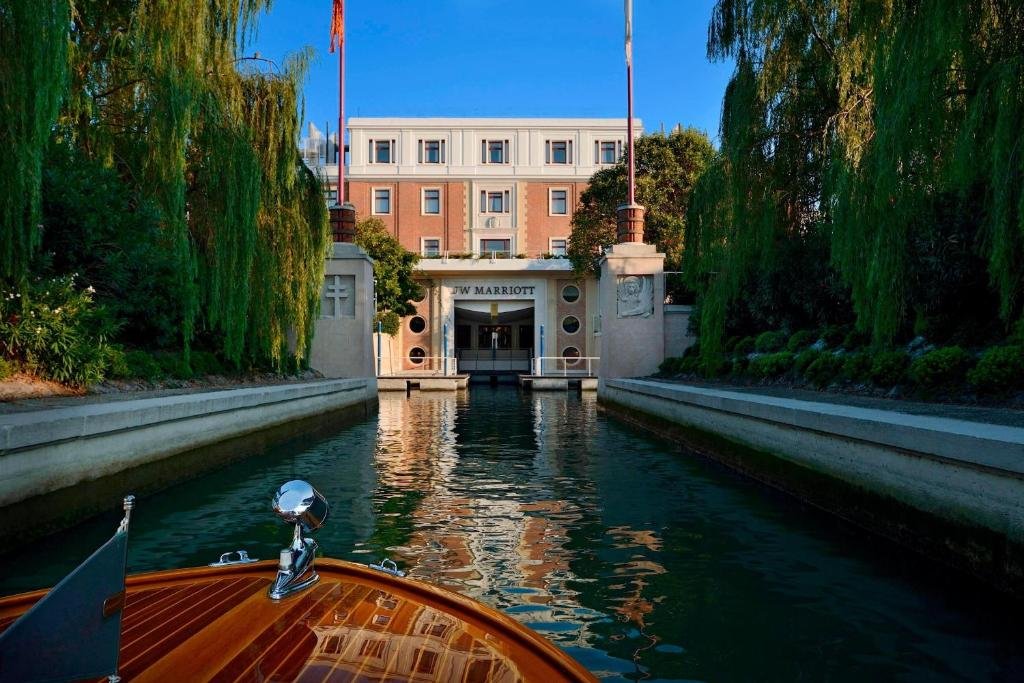
On Isola delle Rose, a former sanatorium has become the kind of five-star hideaway where the seclusion costs a small fortune and is worth every euro of it.
For nearly a century, the only reason to come to this island was because a doctor sent you here. Isola delle Rose was built as an escape from Venice, a place to keep tuberculosis patients away from the crowded, damp city across the water. These days, escaping Venice is still the whole appeal. Minus the tuberculosis. Plus a Michelin star, a rooftop pool, and a boat that means you never have to fight anyone for a table.
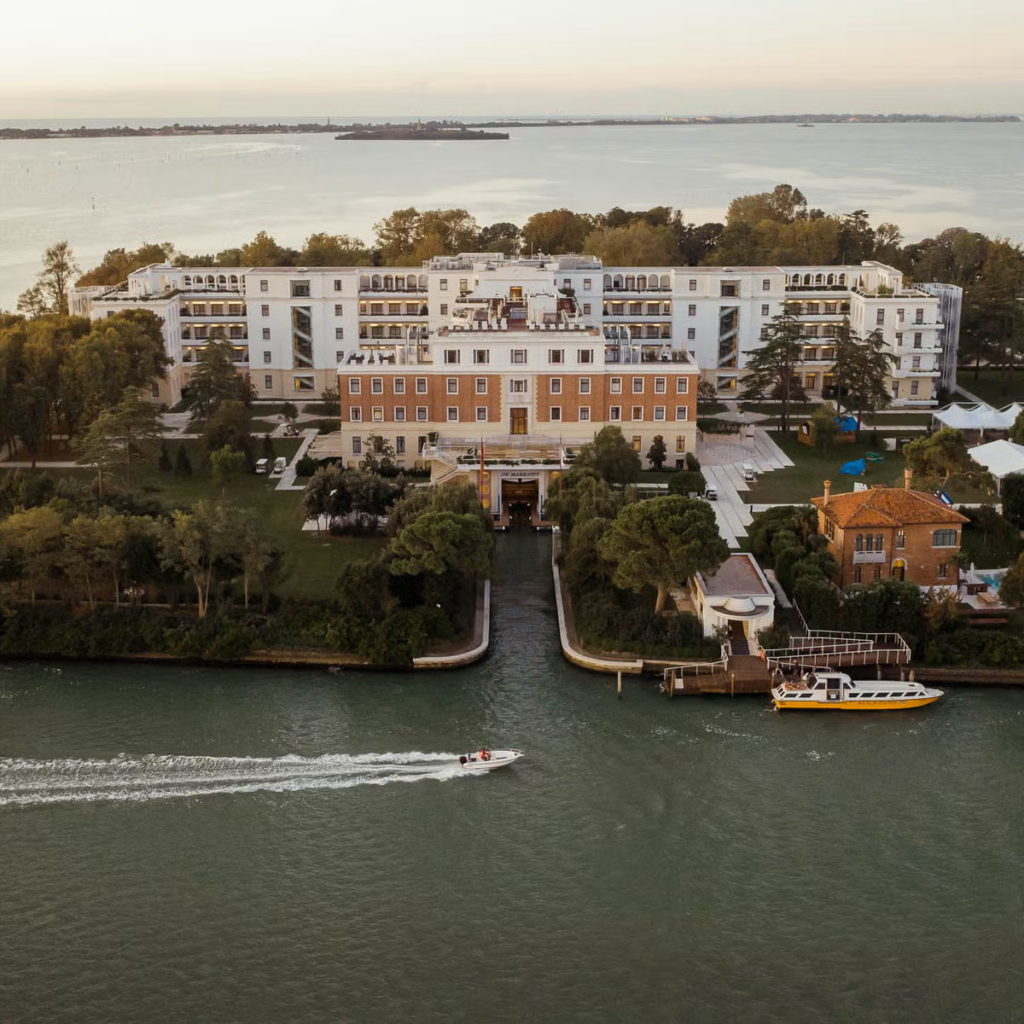
Getting there is part of the theatre, and honestly the correct order of operations for a five-star arrival. The launch peels away from the lagoon’s main channels and, within minutes, Venice stops being a crowd and becomes a skyline, all domes and campaniles receding gracefully behind you while ahead, Isola delle Rose appears as a low green smudge of olive trees and lawns, looking suspiciously like it knows exactly how good it’s about to make you feel. The irony of the island’s history is almost too neat: what was once medical exile is now one of the more expensive ways to be left alone in Venice, and somehow the wellness industry hasn’t yet found a way to make that sound cheesy on a spa menu. Give it time.
A sanatorium that decided to become beautiful
Architect Matteo Thun took on the redesign with a restraint I genuinely didn’t expect from a building with this much money behind it, and the main structure still carries a whisper of its clinical past in its long, light-filled corridors and the discipline of its symmetry. No wellness clichés plastered everywhere, no fake apothecary bottles lining a windowsill for the aesthetic. Everywhere else, the century-old grounds do the talking, and they talk a lot: sixteen hectares of gardens and olive groves, a deconsecrated nineteenth-century church now doing double duty as a wedding venue, and paths that wind past working vegetable beds rather than manicured borders that exist purely to be photographed. I walked the length of the property one evening before dinner and didn’t pass another guest for twenty minutes, which on an island this size, at this price point, felt less like luck and more like the whole business model being quietly, expensively proven in real time.
Five addresses, one island, and a plunge pool if you want it
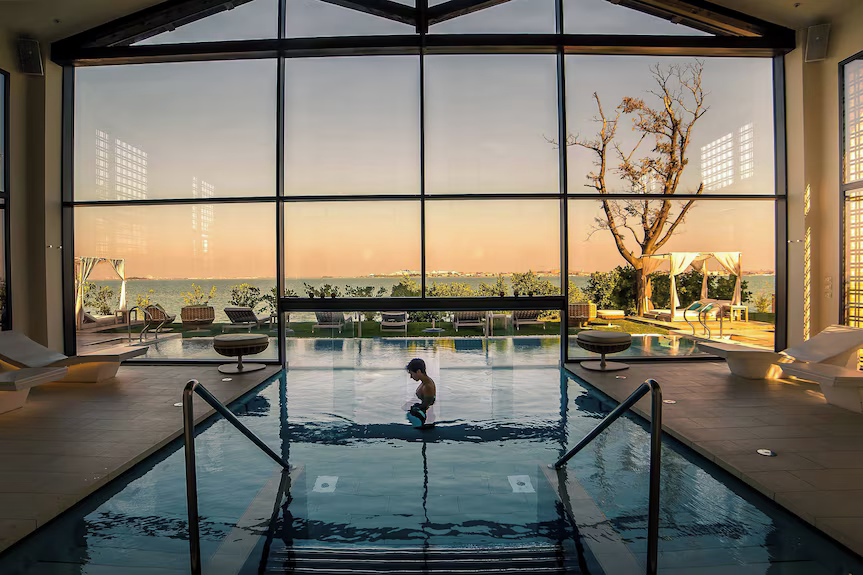
Accommodation here isn’t a single category so much as a small, very well-dressed neighbourhood, and choosing between them is genuinely stressful in the way only good problems are. The main building holds the classic JW rooms and suites, high ceilinged and garden facing, with marble bathrooms deep enough to actually submerge in, not the sad, shallow, Instagram-bait tubs some hotels try to pass off as luxury. La Residenza sits closer to the water, wrapped in greenery with views that flicker between lagoon and city skyline like the hotel can’t decide which flex to lead with. L’Uliveto, my favourite on paper if not on my budget, is set among a genuinely century-old olive grove, the kind of detail that makes a five-star hotel feel like a piece of inherited land rather than a building someone bought a nice logo for. La Maisonette goes loft-style, with private gardens and plunge pools attached to each suite, and Villa Rose, the two-bedroom presidential option, comes with its own four-hundred-and-twenty-square-metre garden and a private pool staring straight across the lagoon at Venice, presumably so you can watch other people fight for a table at Harry’s Bar while you don’t.
I stayed in a JW suite with a terrace that caught the last of the evening light directly over the olive trees, and spent considerably more time out there with a glass of Prosecco than I’d like to admit was reasonable, or productive, or anything close to why I’d technically come to Venice. The bed linen had that particular weight good hotels understand instinctively, heavy enough to feel expensive, light enough not to trap the August heat. No notes. Genuinely.
A Michelin star, a rooftop the colour of terracotta, and cicchetti after dark
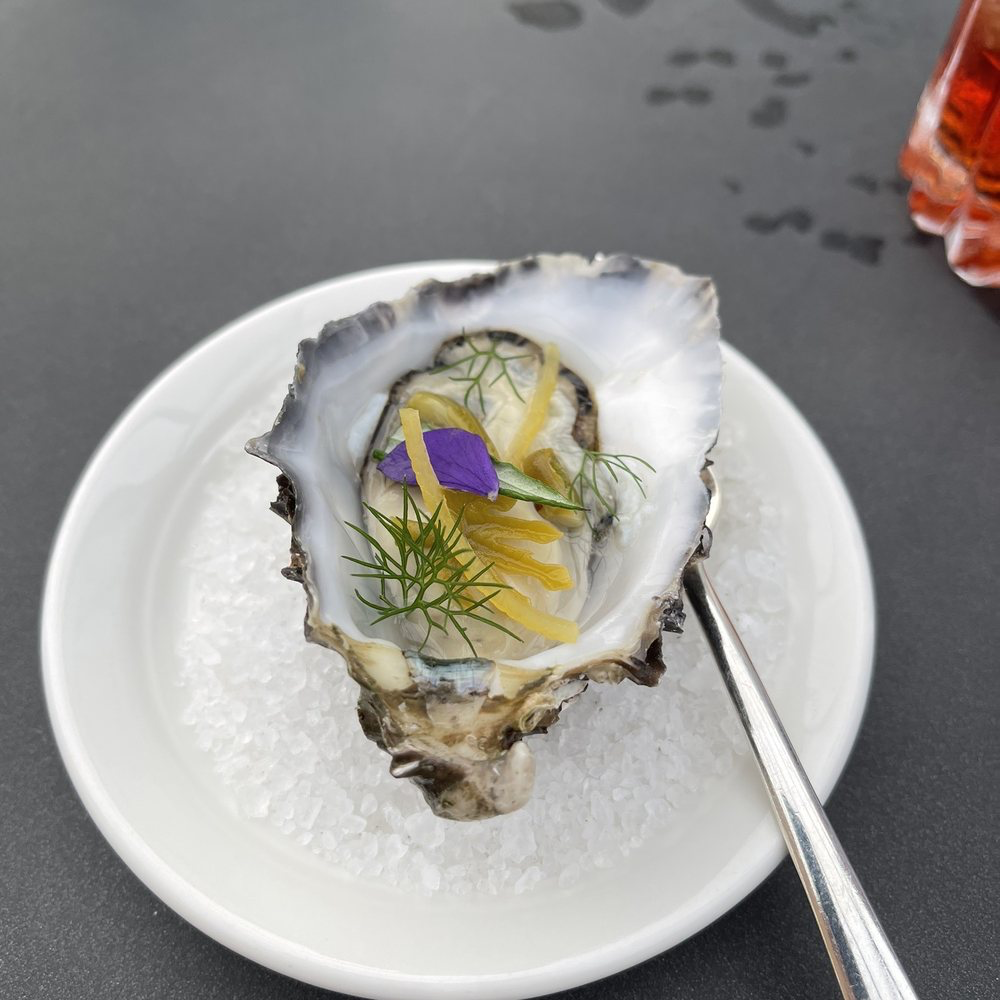
Breakfast happens at Cucina, a ground-floor restaurant built around an open chef’s stage, all pastries and a proper omelette station, and by summer it quietly reinvents itself as an open-air pizzeria for lunch, because apparently even the restaurants here refuse to sit still. Dinner is where the island really earns its reputation, and its prices. Agli Amici Dopolavoro Venezia holds a Michelin star under chef Emanuele Scarello, and the tasting menu leans hard into the lagoon and the land around it, langoustine one course, risotto the next, everything plated with the kind of restraint that lets one good ingredient do the talking instead of six mediocre ones shouting over each other.
But it was Sagra, the rooftop restaurant, that I kept sneaking back to, and I’m not sorry about it. The room takes its colour palette from Venice’s terracotta rooftops, all warm orange and rust, and the 360-degree view over the lagoon means you can watch the light shift over the whole city while working through a plate of cicchetti and a glass of something local, feeling smug about the fact that you didn’t have to fight a single tourist for your table. Much of what lands on the plate comes from the resort’s own vegetable garden, tended by a chef named Lotto whose entire job, as far as I could tell, is keeping the kitchen relentlessly in season. It shows. The tomatoes tasted like they’d been picked that morning, because they had, and once you’ve had a tomato like that, every supermarket tomato you eat for the rest of your life becomes a personal insult.
One of the largest spas in Venice, and absolutely nowhere to be
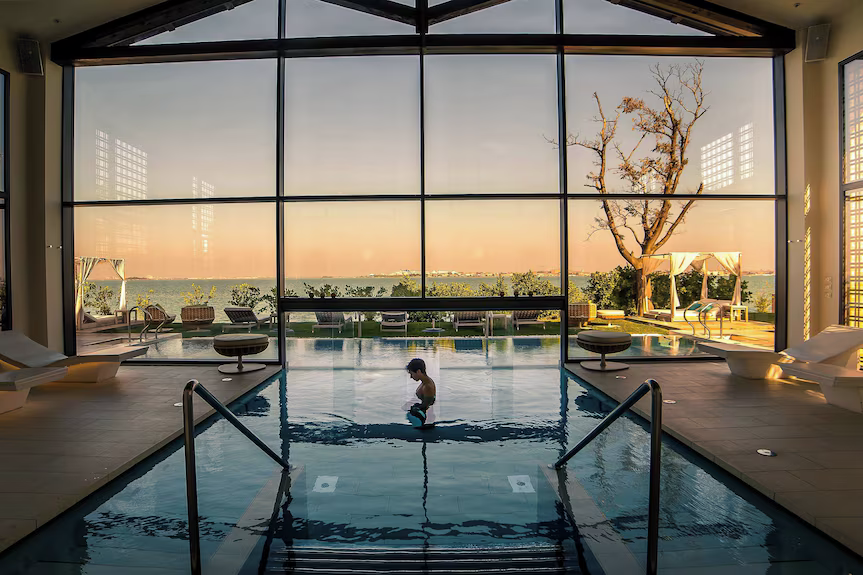
JW Venice Spa is, by most local accounts, one of the largest wellness spaces in the city, and mercifully it uses that scale well rather than just filling it with more of the same treatment room on repeat. Treatments draw on both traditional and more contemporary approaches, and the pace of the place actively discourages the clock-watching most spa visits accidentally turn into. I had a lagoon-inspired facial that leaned on marine ingredients and finished with a scalp massage I genuinely resented having to let end, and walked out to find the light had shifted from afternoon into that particular Venetian gold that makes absolutely everyone look faintly cinematic, myself included, and I will take that compliment from the lighting and nobody else.
There’s a stillness to the spa that the rest of the resort, for all its gardens and rooftop drama, doesn’t quite manage to replicate. Nobody here is trying to get anywhere. That’s rather the entire, expensive point of coming.
Padel courts among the olive trees, and a boat that never keeps you waiting
The rooftop pool deck delivers the same panoramic view as Sagra below it, an infinity edge that seems to fold straight into the lagoon in the kind of shot that makes your friends message you asking if you’re “okay financially”, and there’s a second, quieter family pool tucked into the gardens for anyone who’d rather not share their sunbathing hours with a cocktail menu and other people’s influencer content. Families are properly looked after here, not just tolerated. The kids’ club runs cooking classes and mask-making workshops that riff on Venice’s carnival history, and there’s an outdoor cinema and a sports field for anyone who’s exhausted the pool by 4pm, which, in August, is basically everyone.
For adults, two padel courts arrived in 2024, which felt like a slightly random addition to a resort otherwise built entirely around the art of doing nothing, though I’ll happily admit I used them anyway, competitively, and with more aggression than the setting probably called for. Excursions off the island lean into local craft rather than generic sightseeing, glass-blowing on Murano, lace-making on Burano, the kind of thing that turns a boat trip into an actual afternoon rather than a box to tick before lunch. And that boat matters more than you’d think. The complimentary shuttle to St Mark’s Square runs tightly enough that Venice never feels genuinely far away, even when the island itself feels like a different, much calmer country entirely.
On my last morning I sat on the terrace with coffee, watching the vegetable garden’s early watering ritual and a heron working the shoreline like it also had somewhere very important not to be, and it struck me that the island’s original purpose, isolation for the sake of recovery, had survived the redesign almost entirely intact. It’s just that now you check in voluntarily, pay handsomely for the privilege, and the only thing you’re recovering from is Venice itself.
Practical information
Rates from approximately £340 to £380 a night for a JW Deluxe Room, rising sharply (and unapologetically) for La Maisonette suites and Villa Rose depending on season. The resort operates seasonally, typically March through November, so don’t try turning up in January expecting a heron and a Michelin star. Book directly via marriott.com or through a luxury travel advisor for room upgrades and spa credits, because someone should be fighting for your upgrade while you do absolutely nothing. Getting there: fly into Venice Marco Polo, then transfer by private water taxi or take the complimentary resort shuttle from St Mark’s Square, a twenty-minute crossing that counts as part of the experience rather than a delay before it.