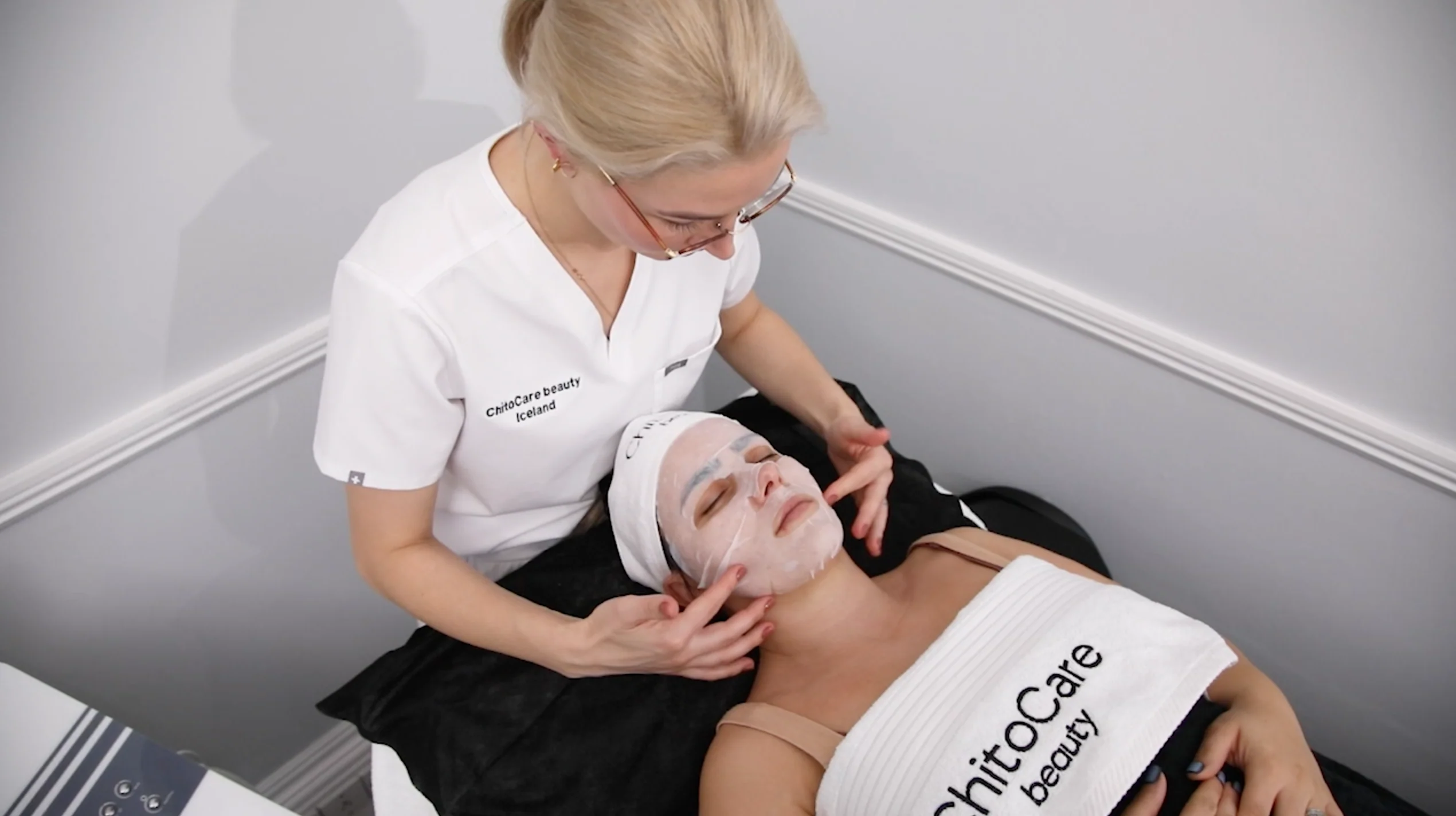
On Harley Street, marine waste is quietly turned into medical-grade skincare, and forty-eight hours after my facial, my skin still hadn’t got the memo that the treatment was over, glowing on days it had no business glowing.
Marine biotechnology is not usually how a facial gets sold to me. Radiofrequency, yes. Electroporation, occasionally, if the clinic wants to sound serious. But the idea that the serum being coaxed into my skin began its life as discarded shrimp shells on a dock in the Arctic Circle felt like something worth falling for, and it is the reason I chose the Signature ChitoCare Beauty Facial over any of the dozen other anti-ageing treatments within five minutes of it.
What pulled me in wasn’t the machinery. Radiofrequency and LED have become fairly standard vocabulary on this stretch of London. It was the tenderness of the logic underneath them: a skincare company built on the belief that what heals a wound can, with enough patience and enough Icelandic science, also soften a decade of sun and sleepless nights. I wanted to know whether that logic held up on an actual face. Mine, worn a little thin by a year I would rather not detail.
It Looks Like Harley Street. It Doesn’t Feel Like It.
Harley Street has a house style, and it is beige efficiency: reception desks built for turnover, waiting rooms that want you gone in under four minutes. ChitoCare has clearly decided against that. The clinic, which opened its doors here in November 2024, feels closer to a considered private practice than a walk-in medi-spa, softly lit and unhurried in a way this postcode rarely allows itself to be. Low light in the corridor. No queue. Even the pace felt deliberate, as though someone had decided early on that a treatment built on patience should be preceded by some.
The treatment room itself was small and unfussy: a single bed, a tray of devices laid out with more precision than drama, and a window dressed to let in light without letting in the street. Nothing about it tried to look expensive. It just was, in the way a genuinely good tailor’s shop never needs to raise its voice.
Karolina mentioned who tends to come through the door, and did so lightly, almost in passing, the way you’d share a small secret rather than recite a marketing line: a fair number of Harley Street locals booking a session into their lunch hour, a quieter, steadier stream of clients flying in from further afield, and, from time to time, a royal or a recognisable face who has come to trust this particular address to keep it that way.
Karolina Knows the Whole Icelandic Story
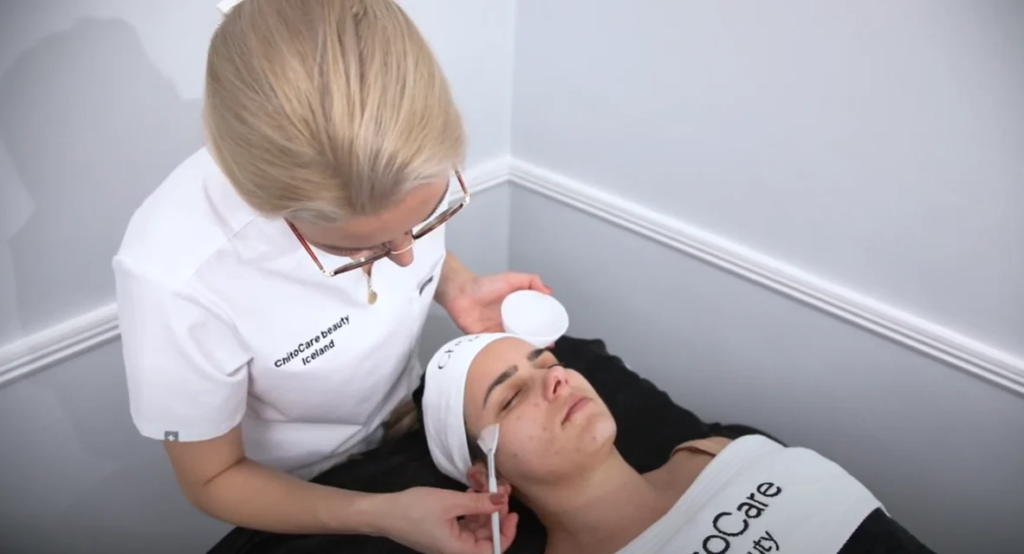
ChitoCare‘s lead aesthetician, Karolina, spent the first stretch of my consultation somewhere I didn’t expect to end up, tracing the brand back to a fishing town in the north of Iceland before she so much as looked at my skin. She told it softly, unhurried, the way someone talks when they truly believe what they’re about to tell you, her hands already warm against my cheeks as she spoke. By the time she reached for the first device, I understood why the facial costs what it does.
Siglufjörður, she told me, twenty-five miles south of the Arctic Circle, is where a company called Primex Iceland set up in 1999 to do something with the mountains of shrimp shells the local seafood industry was throwing away. What they extracted was chitosan, a biopolymer pulled from the shells of wild, cold-water Northern shrimp, and for years it went into medical products nobody would think to call glamorous: wound dressings, blood-clotting gels, sprays to stop infection in burns units. It was only when researchers noticed that patients healing from severe burns were left with skin that was smoother and calmer than skin that had never been injured that anyone thought to put it in a jar. Sigga Vigfúsdóttir, the company’s founder, launched ChitoCare Beauty in 2018 on the back of that observation.
She explained the film effect, the way chitosan settles over the skin as a breathable barrier that locks in hydration without ever feeling heavy, and the fact that it behaves as what she called a booster, a delivery vehicle that carries everything applied alongside it deeper than it could manage alone. She wasn’t selling me a facial. She was sharing something she loved, and she clearly found the material more moving than the sales pitch, which is exactly the kind of clinician I want holding a radiofrequency device an inch from my cheekbone.
Radiofrequency First, Then a Door Opens in the Skin
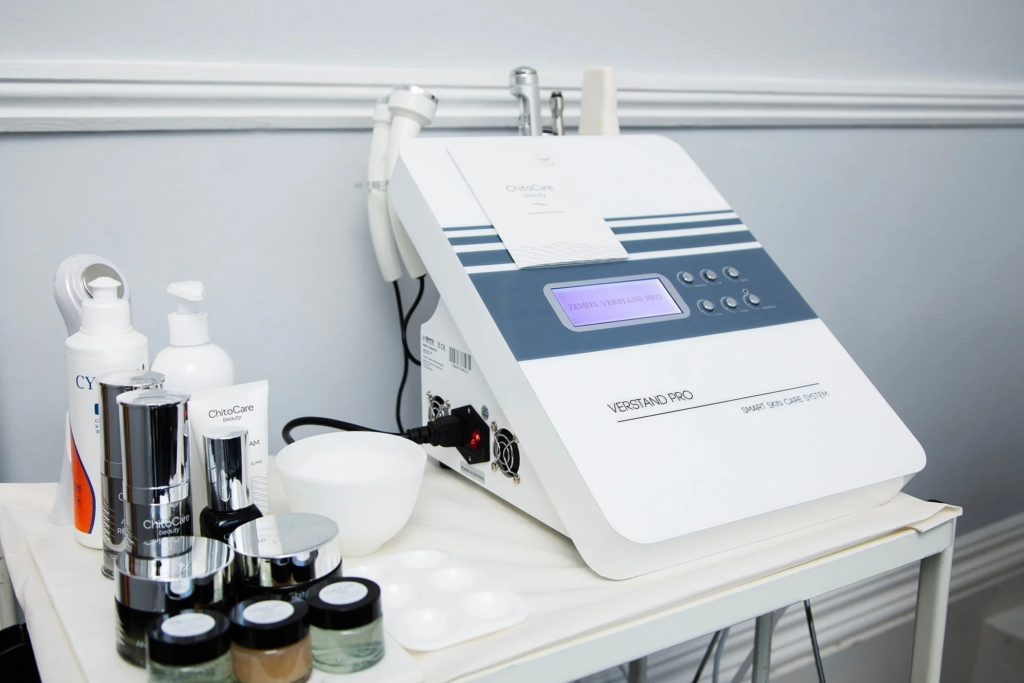
The treatment runs seventy minutes, and it does not waste any of them.
It starts with a proper double cleanse, first a gentle pre-cleanse to lift make-up and the day’s grime, then a second, more thorough pass to leave the skin bare and ready for what was coming. Karolina moved through this quickly and without ceremony, the sense being that this part is preparation, not performance.
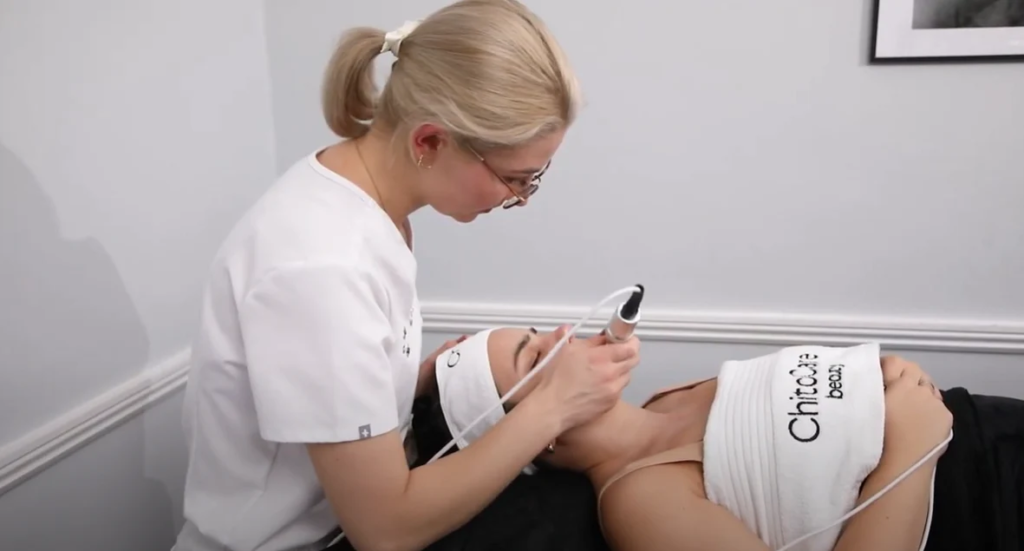
Then came the bi-polar radiofrequency, worked in slow, deliberate passes across the jaw, cheeks and neck, the wand gliding rather than pressing. It is warm rather than hot, a gentle, controlled heat that sits under the surface rather than on it, and Karolina explained she was aiming to contract existing collagen fibres while coaxing the skin into producing new ones, the neocollagenesis the brand’s own literature is so fond of citing. I could feel it working somewhere below where I could consciously register it, a strange sensation to describe and a stranger one still to lie there and simply enjoy.
The electroporation stage is where the ingredient story stopped being theoretical. A handheld device sent mild electrical pulses across my skin, temporarily opening microscopic channels in the cell membrane, and through those channels Karolina drove a high concentration of the ChitoCare Repair serum. This is not a treatment that leaves the active ingredients to sit hopefully on top of the skin and hope for the best. It pushes them in. There was a faint, prickling tingle, more curious than uncomfortable, and I remember thinking, half amused, that this was probably the closest a facial gets to feeling like a procedure rather than a pamper.
A sculpting and drainage massage followed, and it was the part of the treatment that felt closest to being cared for rather than worked on. Karolina moved along the jaw and up through the cheekbones with real, confident pressure, coaxing circulation and lymphatic drainage, and easing out a knot of tension along my jaw I hadn’t even clocked I was carrying. Then came the 830-nanometre LED, a deep red wash of light laid over the face to calm any inflammation the radiofrequency and electroporation had stirred and to gently speed the skin’s own repair. The room went quiet. My shoulders dropped somewhere around minute forty. I did not want it to end.
The finish is where the barrier gets sealed gently back up: a layer of the brand’s own anti-ageing night cream, smoothed on with the same unhurried care as everything before it, followed by broad-spectrum sun protection, locking in everything that had just been coaxed into the skin over the previous hour.
The Serum With the Numbers to Prove It
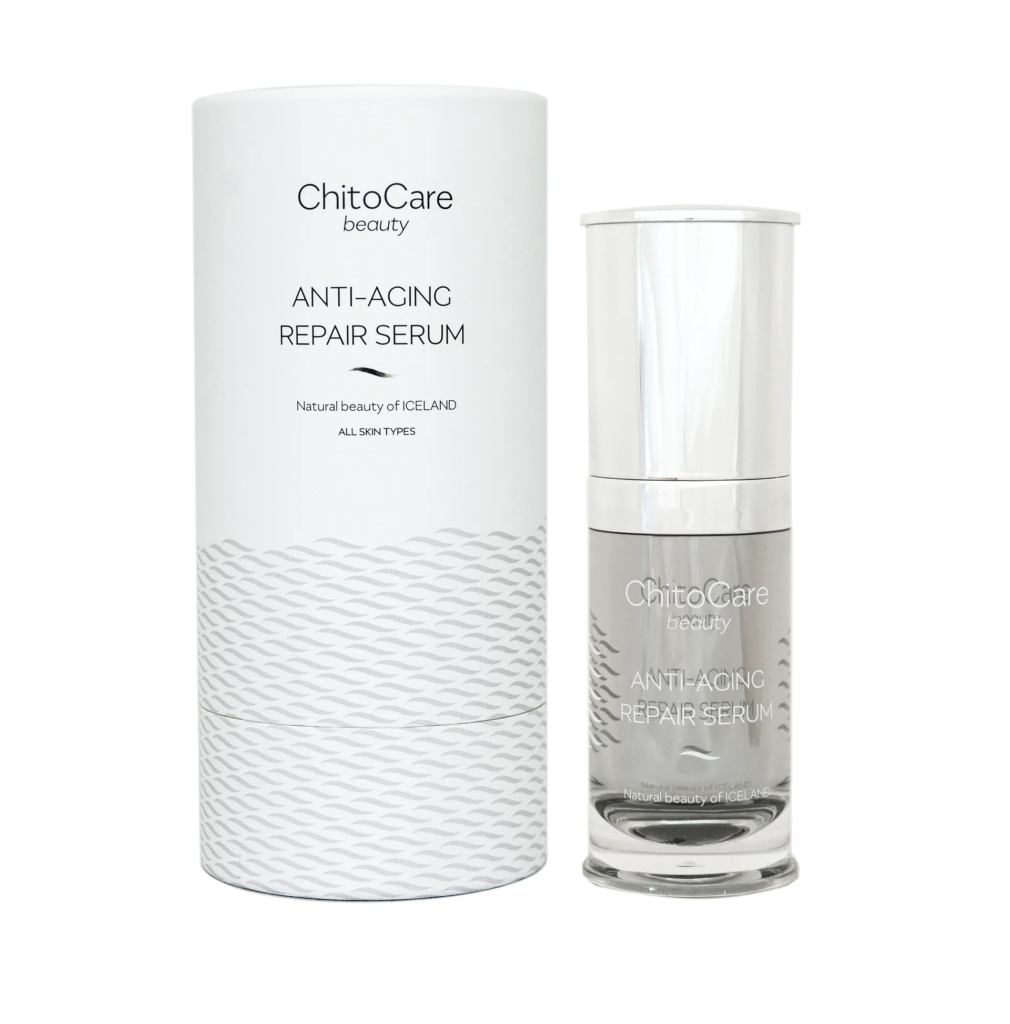
The ChitoCare Repair complex used throughout the facial is the same one anchoring the brand’s retail range, and the range has picked up more recognition than a niche Icelandic skincare line arguably has any right to. Its Anti-Ageing Repair Serum, built around the same marine chitosan paired with hyaluronic acid, has been independently tested to reduce roughness by nineteen per cent and increase firmness by twenty-two per cent. The Anti-Ageing Night Cream, the one smoothed on at the end of my facial, was picked as a winner in the Tatler Beauty and Cosmetic Surgery Guide. There is a Healing Gel dermatologists reach for after more invasive procedures, and a Marine Super Hydration Mask from the brand’s INNSÆI spa collection, soaked in geothermal silica and marine collagen, that I have since added to my own list of things to track down. None of it reads as vanity marketing once you have sat through Karolina’s version of the origin story. It reads like a company that keeps quietly, patiently proving the same point.
Forty-Eight Hours Later, My Face Still Hadn’t Got the Memo
I left with a genuine glow, not the flushed, overworked look some radiofrequency treatments leave behind, but something softer and more even, the kind you catch in the mirror all evening without meaning to. Karolina was firm about aftercare in a way I appreciated: no cleansing that night, so everything coaxed into the skin during the electroporation stage had time to settle rather than being washed straight back out.
By the following morning the difference was already visible: less puffiness along the jaw, a texture that felt closer to satin than skin usually manages on a Tuesday. By forty-eight to seventy-two hours, my skin had a plumpness I don’t usually associate with a single appointment, and several of the finer lines around my eyes had softened enough that I stopped noticing them, which for me is the real test. Foundation sat differently. My skin looked rested on a week I most certainly hadn’t been. I was told the results build with repetition, that most visible change lands around the four-week mark, and that a course of three sessions is where the transformation properly compounds. On the evidence of one, I believe it. I am already trying to work out how to justify the other two.
What stayed with me longest wasn’t the tightening or even the glow, though both were real. It was leaving a Harley Street clinic having spent the last hour thinking tenderly about a fishing town in the north of Iceland, and about a company that looked at a mountain of shrimp shells and decided to heal skin with it instead of throwing it away. I have caught myself explaining this, unprompted, at two dinner parties since. That is either a mild new obsession or proof the facial worked. I suspect both.
The details: The Signature ChitoCare Beauty Facial runs 60 to 70 minutes and costs £200 at the ChitoCare Clinic on Harley Street, London. A course of three is recommended for cumulative results, with visible change typically emerging from around four weeks. The clinic also offers Calm & Protect and Purifying facials for those wanting a gentler entry point. Book through the ChitoCare UK site.